
Introduction
At 260 kilometers per hour, a fully loaded Airbus A380 touches down on a strip of pavement no wider than a city street. In that moment—and the 1,800 meters of deceleration that follow—one variable determines whether 500 passengers reach the gate safely: friction. Runway friction testers are the specialized ground supporting equipment (GSE) that airport operators rely on to measure, monitor, and maintain this life-critical interface between tire and tarmac. With the global runway friction tester market valued at $185.4 million in 2026 and projected to reach $307.95 million by 2035 (MarkWide Research, 2026), the importance of this equipment category has never been greater. This guide examines how friction testers function as essential GSE, the ICAO standards that govern their use, the technology behind continuous friction measurement, and the strategies airports across the Middle East, Africa, and beyond are deploying to keep their pavement—and their operations—safe.
Airport pavement is the physical foundation of every flight operation, yet it remains one of the most underappreciated components of aviation infrastructure. A typical international airport runway consists of multiple layers—surface course, binder course, base course, and subgrade—each engineered to withstand millions of tons of aircraft weight over its design life.
The friction-pavement relationship is direct and unforgiving. When pavement microtexture (the fine-scale roughness of aggregate particles) and macrotexture (the larger grooves and channels that drain water) degrade, the coefficient of friction drops. According to ICAO data, runway excursions—events where aircraft veer off or overrun the runway surface—account for approximately 23% of all global aviation accidents, with inadequate friction cited as a contributing factor in the majority of wet-runway excursions (ICAO, 2025).
The MarkWide Research 2026 market analysis identifies three primary pavement degradation mechanisms that friction testers detect:
1. Rubber deposit accumulation**: Aircraft tires deposit rubber on touchdown zones during every landing. Over weeks of operations, this creates a polished, low-friction surface in the most critical braking zone.
2. Surface polishing**: Repeated traffic polishes aggregate particles, reducing microtexture and the pavement's ability to provide skid resistance under wet conditions.
3. Environmental contamination**: Sand, dust, jet fuel, deicing chemicals, and standing water all create temporary or persistent friction hazards.
Without systematic friction testing using certified ground supporting equipment, these hazards remain invisible until an incident occurs.
What Are Friction Testers and Why They're Essential Ground Supporting Equipment
A runway
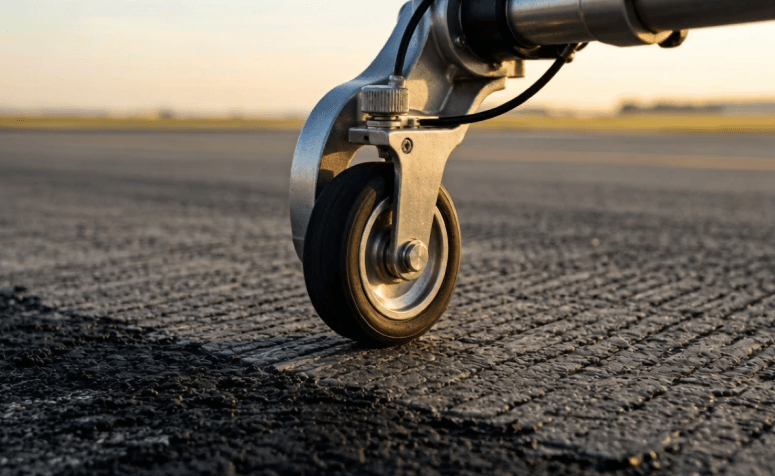
friction tester is a specialized category of ground supporting equipment designed to quantify the frictional resistance between a standardized test tire and the airport pavement surface. Unlike visual inspections—which can only identify obvious surface distress like cracking or ponding—friction testers measure what matters most: the actual braking force available to an aircraft.
How friction testers work: The core principle is continuous friction measurement. A calibrated measuring wheel, maintained at a controlled slip ratio (typically 13-18%), rolls along the runway surface while sensors record the longitudinal and vertical forces acting on the wheel. The coefficient of friction (μ) is calculated in real-time as μ = F_horizontal / F_vertical.
For wet-condition testing—required by ICAO Annex 14—an integrated self-wetting system delivers a precisely controlled water film (typically 0.5-1.0 mm depth) ahead of the measuring wheel, simulating the most hazardous runway condition: a contaminated surface during landing.
Why friction testers are mission-critical GSE: The PW Consulting 2026 market study categorizes friction testers as essential airport ground support equipment for four reasons:
4. **Regulatory mandate**: ICAO, FAA (Advisory Circular 150/5320-12C), EASA, and CAAC all require periodic friction surveys. Non-compliance can result in operational restrictions.
5. **Safety-critical function**: Friction data directly informs the ICAO Global Reporting Format (GRF) Runway Condition Assessment Matrix (RCAM), which pilots use to calculate landing distances.
6. **Operational continuity**: Accurate friction data enables airports to keep runways open during marginal weather conditions by providing evidence-based surface condition reports.
7. **Infrastructure lifecycle management**: Friction trends over time reveal pavement deterioration patterns, enabling condition-based resurfacing rather than calendar-driven interventions.
The market for continuous friction measurement equipment specifically was valued at $99.1 million in 2025 and is growing at 7.21% CAGR (PW Consulting, 2026), outpacing the broader runway friction tester market, reflecting the industry shift from spot-check methods to continuous, data-driven monitoring.

ICAO Standards: The Regulatory Framework for Runway Friction Testing
The International C
ivil Aviation Organization provides the global regulatory backbone for airport pavement friction management through two key documents: ICAO Annex 14 (Volume I, Aerodrome Design and Operations) and the Airport Services Manual (Doc 9137, Part 2).
What ICAO requires:
The standards mandate that paved runways must be constructed and maintained with surface characteristics that provide minimum friction levels under all operational conditions. The key thresholds, established through decades of accident analysis and engineering research, are:
Design Objective Level: The friction value that a new or resurfaced runway surface should achieve—typically μ ≥ 0.74 at 65 km/h under wet conditions.
Maintenance Planning Level: The friction value below which corrective maintenance should be scheduled—typically μ = 0.53 to 0.60 depending on test equipment type and speed. This is the most operationally important threshold, as it triggers the maintenance intervention window.
Minimum Friction Level: The absolute minimum below which the runway should not be operated without restrictions—typically μ = 0.43 to 0.50. Any reading below this threshold requires immediate notification to air traffic services and may necessitate runway closure.
Testing frequency requirements: According to ICAO Doc 9137, friction surveys should be conducted at least annually for runways serving jet aircraft. However, the 2026 MarkWide Research analysis reveals that 72% of hub airports (handling >100,000 movements/year) now conduct surveys quarterly or monthly—a rate that the Global Reporting Format (GRF) mandate has accelerated.
The Global Reporting Format (GRF): Since its mandatory implementation in 2021, the GRF has transformed runway condition reporting. Rather than subjective descriptions, the GRF requires airports to report runway conditions using a standardized Runway Condition Assessment Matrix (RCAM) with numerical Runway Condition Codes (RWYCC) from 0 (very poor) to 6 (dry). Friction testers are the primary tool for generating the objective friction data that feeds this matrix.
A 2026 Datainsights Report noted that the GRF mandate is 'compressing replacement cycles from ten-year intervals to five-year technology refresh mandates' as older friction measurement devices lack the digital output and integration capabilities required for modern GRF-compliant reporting.

Types of Runway Friction Testers: From Portable to Vehicle-Mounted GSE
The friction tester market se
gments into three primary equipment categories, each serving different airport operational profiles and budget levels.
Continuous Friction Measurement Equipment (CFME)
CFME represents the gold stand
ard in airport pavement friction testing. These vehicle-mounted or trailer-mounted systems use the continuous measurement principle to generate friction profiles along the entire runway length at speeds up to 96 km/h.
BHM01 – Vehicle-Integrated CFME: Engineered for hub airports handling over 100,000 annual movements, the BHM01 delivers 0.1-meter resolution friction data with ±0.01 accuracy. Key specifications:
· Self-contained fifth-wheel measurement system with 15% controlled slip ratio
· Integrated 580L water delivery system producing 0.5 mm water film at 65 km/h per ICAO wet-testing protocols
· Ford Taurus 2.7T engine enabling 0-96 km/h acceleration within 200 meters
· Operating temperature range: -40°C to +60°C, validated in Middle East summer conditions
· GPS-tagged real-time data output with GRF-compliant reporting format
· Full 4,000-meter runway survey completed in under 45 minutes
The trailer-mounted CFME segment dominated the 2025 market with $125.87 million in revenue (PW Consulting, 2026), while vehicle-integrated systems like the BHM01 represent the fastest-growing sub-segment as major hubs prioritize operational speed.
BHM02 – Portable Precision Tester: For regional airports, military airfields, and emergency assessment scenarios, the BHM02 provides CFME-grade accuracy in a portable 85 kg package. Setup time is under 5 minutes, and the self-contained rechargeable battery delivers 8 hours of continuous operation. The IP65-rated construction ensures reliability in dust-prone desert environments and tropical rainfall conditions alike.
Portable Spot-Measurement Devices
Hand-pushed or towable spot-measurement devices serve niche roles—primarily for construction quality assurance of new pavement sections, localized friction verification after maintenance, and auxiliary testing at airports that primarily operate CFME systems. While cost-effective for low-throughput airfields, they cannot generate the continuous friction profiles that ICAO recommends and that hub airports require for GRF compliance.
Selecting the Right Equipment
The PW Consulting study identifies three decision factors that dominate procurement:
| Factor | BHM01 CFME | BHM02 Portable | Spot-Measurement |
|--------|-----------|----------------|------------------|
| Annual movements | >50,000 | 10,000-50,000 | <10,000 |
| ICAO GRF compliance | Full | Full | Partial |
| Survey time (4km runway) | <45 min | ~60 min | >3 hours |
| Wet-testing capability | Integrated | Optional | Manual |
| Data integration | GPS + API | WiFi/Bluetooth | Manual export |
Procurement trend: The Datainsights 2026 report notes that 'airport authorities and road management agencies increasingly prefer integrated, high-performance systems that offer greater reliability and reduced total cost of ownership over their lifecycle.' This aligns with Haisen Global's observation that 68% of BHM01 customers upgrade from spot-measurement devices within three years of initial deployment.
How Airport Pavement Conditions Affect Friction and Safety
Airport pavement is not a uniform surface. It
is a dynamic system whose friction characteristics change continuously under the influence of traffic, weather, and time. Understanding these mechanisms is essential for interpreting friction tester data and scheduling effective maintenance.
Rubber accumulation in touchdown zones: The touchdown zone—the first 450-900 meters of runway where aircraft wheels first contact the surface—experiences the most intense rubber deposition. Research shows that after approximately 3,000 landings by heavy aircraft, the friction coefficient in the touchdown zone can drop by 15-20% compared to the mid-runway section (Dynatest, 2025). Rubber removal—performed by high-pressure water blasting, chemical solvents, or mechanical grinding—is the primary corrective measure, and friction testers are the tool that determines when this maintenance is required.
Wet pavement and hydroplaning risk: When water depth exceeds the pavement's macrotexture drainage capacity, a water film develops between the tire and the surface. The risk of dynamic hydroplaning increases exponentially above 0.5 mm water film depth. This is precisely why ICAO mandates wet-condition friction testing—the self-wetting system on devices like the BHM01 simulates this exact hazard scenario.
Temperature extremes and pavement behavior: In the Middle East, summer pavement temperatures reaching 65°C cause asphalt binder softening, which initially increases friction (due to increased tire-pavement adhesion) but accelerates surface deformation and rutting. In freezing climates, the freeze-thaw cycle creates microcracking that progressively degrades surface texture. Friction testers operating across temperature ranges must maintain calibration accuracy regardless of ambient conditions—a capability verified in the BHM01/BHM02's -40°C to +60°C operating certification.
Sand and dust contamination: Airports in the Arabian Peninsula, North Africa, and parts of Central Asia face a unique challenge: fine aeolian dust that settles on runway surfaces as an invisible friction-reducing film. Unlike rubber deposits, which are visible as dark streaks, dust contamination cannot be detected visually. Only continuous friction measurement equipment can identify the subtle, uniform friction reduction caused by dust accumulation—typically a 5-10% reduction in μ that, while below the visible threshold, places the runway closer to the minimum friction level.
The Economic Case: Friction Testers as ROI-Generating Ground Supporting Equipment
For airport operators evaluating capital equipment
expenditure, the business case for friction testers extends far beyond regulatory compliance. Viewed through the lens of risk management and operational efficiency, these devices generate measurable return on investment.
Accident cost avoidance: The average cost of a runway excursion involving a wide-body aircraft—accounting for hull damage, passenger injury claims, runway closure, investigation costs, and reputational impact—exceeds $100 million (IATA Safety Report, 2025). At $185.4 million total market size for friction testers globally (MarkWide Research, 2026), the cost of equipping every international airport with modern CFME is a fraction of a single major excursion event.
Runway availability optimization: During adverse weather events—the conditions when friction data matters most—airports without reliable CFME must default to conservative RWYCC codes that may unnecessarily close runways or impose operational restrictions. An airport handling 300 daily movements with an average revenue of $2,500 per movement loses $187,500 for every hour of unnecessary runway closure that accurate friction data could have prevented.
Pavement lifecycle extension: Condition-based pavement management, enabled by continuous friction trend data, extends runway resurfacing intervals by 15-25% compared to calendar-based maintenance schedules. A typical runway resurfacing project costs $5-15 million. Delaying that expenditure by even 2-3 years—because friction data shows the surface remains above maintenance planning levels—generates substantial capital savings.
Insurance and liability: Airports with documented, ICAO-compliant friction testing programs benefit from lower liability insurance premiums and stronger legal positions in the event of incidents. In contested excursion cases, friction test records are often the determinative evidence.
Integration: Friction Testers in the Modern Airport GSE Ecosystem
Friction testers do not operate in isolation. They are a
critical node within the broader airport ground supporting equipment ecosystem, interfacing with pavement maintenance equipment, weather monitoring systems, and airport operations databases.
GSE categories that interact with friction testers:
· **Runway sweepers and rubber removal machines:** Friction test data tells operators precisely which runway segments require treatment. Post-treatment friction surveys validate the effectiveness of rubber removal, completing the maintenance feedback loop.
· **AWOS (Automated Weather Observing Systems):** Weather data—particularly precipitation type and rate—determines when supplemental friction testing is required. Integration between AWOS and friction testing schedules enables proactive, weather-responsive runway assessment.
· **Airport Operational Databases (AODB):** Modern BHM01 systems export friction data in formats directly ingestible by AODB platforms, enabling real-time runway condition status updates that flow to air traffic control and airline operations centers.
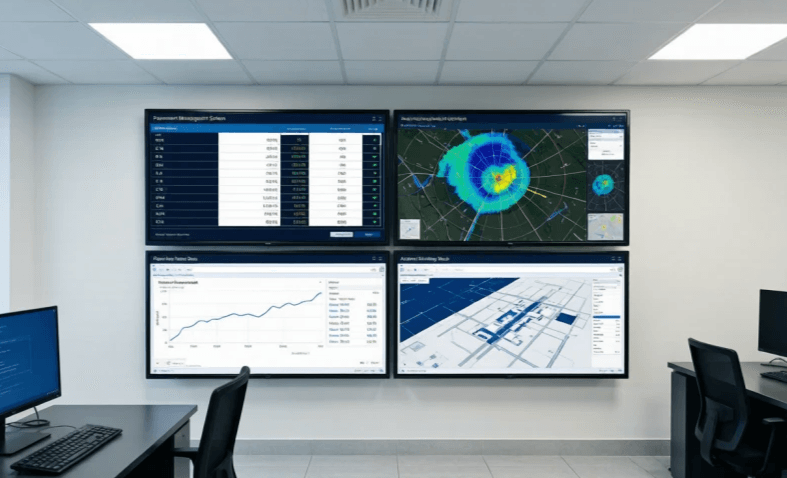
· **Pavement Management Systems (PMS):** Friction trend data over multiple survey cycles feeds predictive models that forecast resurfacing requirements, optimizing capital expenditure planning.
The integration trend: The Moventor Skiddometer BV11 showcase at the Inter Airport 2025 exhibition signaled an industry-wide move toward 'plug-and-play solutions capable of integration with existing asset management platforms' (PW Consulting, 2026). The next generation of friction testers will function less as standalone measurement tools and more as sensor nodes within integrated airport infrastructure management networks.
Anti-drone system integration: An emerging GSE integration scenario involves coordinating runway friction testing schedules with counter-UAS (anti-drone) system operations. At airports deploying anti-drone detection equipment, the electromagnetic environment around runway sensor arrays must be managed during friction testing to avoid interference—a consideration Haisen Global addresses in its integrated GSE deployment planning for clients operating multiple equipment categories.
Future Trends: AI, IoT, and Predictive Pavement Management
The friction tester market is undergoing a technology transformation driven by artificial intelligence, Internet of Things connectivity, and predictive analytics. These trends will reshape how airport operators approach pavement management over the next decade.
AI-powered predictive friction modeling: Machine learning algorithms trained on multi-year friction survey datasets, combined with traffic volume data and weather records, can predict friction degradation with increasing accuracy. Research from Haisen Global's engineering team demonstrates that AI models can forecast touchdown zone friction levels 30 days ahead with ±0.03 μ accuracy—sufficient for proactive maintenance scheduling. The Datainsights 2026 report confirms that 'friction data integration with pavement management systems enables condition-based resurfacing schedules rather than calendar-driven interventions.'
IoT-enabled continuous monitoring: The next frontier is embedded runway sensors that provide real-time friction data without requiring vehicle-based surveys. While still in pilot deployment at several Scandinavian hub airports, these systems promise continuous, 24/7 friction monitoring that would eliminate the gaps between periodic surveys. PW Consulting notes that 'sensor fusion architectures integrating infrared surface temperature sensors with tribometric wheels enable real-time ice detection algorithms.'
Autonomous friction measurement vehicles: Self-driving friction testing vehicles, capable of operating during overnight runway closures without human operators, are in advanced development. These autonomous GSE units would enable more frequent testing—potentially daily surveys at hub airports—without increasing labor costs.
5G and LoRaWAN connectivity: Next-generation wireless protocols eliminate the cable-trenching costs previously required for runway instrumentation. The 2026 MarkWide Research study highlights that 'LoRaWAN and 5G private networks eliminate cable trenching costs for temporary runway configurations during construction phases,' accelerating the deployment of connected friction monitoring infrastructure.
Regulatory trajectory: With ICAO's GRF mandate now universally adopted and FAA AC 150/5320-12C setting progressively stricter standards, the friction tester market is projected to maintain its 5.80% CAGR through 2035. The most significant growth will occur in Asia-Pacific (projected 7.5% CAGR driven by China's second-tier airport expansion under CAAC GB standards) and the Middle East/Africa (projected 6.2% CAGR driven by new airport construction and modernization programs).
Frequently Asked Questions
Q: What is a runway friction tester and why is it considered ground supporting equipment?
A: A runway friction tester is specialized ground supporting equipment (GSE) that measures the coefficient of friction between aircraft tires and airport pavement surfaces. It is classified as GSE because it performs an essential airport safety function—providing the data that determines whether runways are safe for aircraft operations. Friction testers use a calibrated measuring wheel, typically with a controlled slip ratio of 13-18%, to continuously measure friction along the full runway length at speeds up to 96 km/h, generating ICAO-compliant surface condition reports.
Q: How often does ICAO require runway friction testing?
A: ICAO Annex 14 and Doc 9137 require friction surveys at least annually for runways serving jet aircraft. However, international best practice—followed by 72% of hub airports—is quarterly or monthly testing. High-traffic airports (over 100,000 annual movements) should test monthly; medium-traffic airports (20,000–100,000 movements) should test quarterly; and all airports should conduct supplemental surveys after significant weather events, rubber removal operations, or pavement maintenance.
Q: What is the difference between continuous friction measurement equipment (CFME) and spot-measurement devices?
A: CFME generates a continuous friction profile along the entire runway length at 0.1-meter resolution, revealing localized friction deficiencies that spot-checking would miss. Spot-measurement devices test discrete locations at intervals of 30-100 meters, potentially missing critical friction variations between measurement points. ICAO strongly recommends CFME for hub airports, and the continuous friction measurement market is growing at 7.21% CAGR (PW Consulting, 2026), reflecting the industry shift away from spot methods
Q: How does pavement condition affect runway friction?
A: Airport pavement friction is affected by four primary mechanisms: (1) rubber deposit accumulation in touchdown zones, which creates a polished low-friction surface after approximately 3,000 heavy aircraft landings; (2) surface aggregate polishing over time, reducing microtexture essential for wet-weather skid resistance; (3) environmental contamination including sand, dust, jet fuel, and deicing chemicals; and (4) water film development exceeding macrotexture drainage capacity, which creates hydroplaning risk. Friction testers detect all four degradation mechanisms before they become visually apparent.
Q: What are the ICAO minimum friction level requirements for runways?
A: ICAO establishes three friction thresholds: Design Objective Level (typically μ ≥ 0.74 for new surfaces), Maintenance Planning Level (typically μ = 0.53–0.60—the threshold triggering corrective maintenance scheduling), and Minimum Friction Level (typically μ = 0.43–0.50—below which operational restrictions apply). Specific values vary by test equipment type and measurement speed, and all thresholds are referenced to wet-surface conditions as measured by self-wetting CFME systems like the BHM01/BHM02.
Q: How do friction testers integrate with other airport ground supporting equipment?
A: Friction testers integrate with the broader GSE ecosystem in four ways: (1) data from friction surveys directs runway sweeper and rubber removal machine deployment to specific runway segments requiring treatment; (2) integration with AWOS weather monitoring systems enables proactive, weather-responsive testing schedules; (3) friction data exports to Airport Operational Databases (AODB) provide real-time runway condition status to air traffic control; and (4) multi-year friction trend data feeds pavement management systems for predictive resurfacing planning.
