
1. What Is FOD and Why Does It Matter?
Foreign Object Debris (FOD) is any object — a bolt, a piece of tire rubber, a metal tool, or a stray stone — that does not belong on an airport's operational surface and poses a hazard to aircraft. Left undetected on a runway, taxiway, or apron, FOD can be ingested into a jet engine, punctured through a tire, or thrown by a wheel into the fuselage, causing damage that ranges from expensive repairs to catastrophic failure.
The financial toll is staggering. Conservative estimates suggest that FOD causes at least $3–4 billion in direct global losses every year — a figure that excludes the indirect costs of flight cancellations, aircraft downtime, injury compensation, and reduced transport capacity. Two accidents underscore the stakes: on July 25, 2000, Air France Flight 459 (a Concorde) crashed after striking a metal strip on the runway, and on May 12, 2009, Japan Airlines Flight 61 experienced a serious FOD-related incident. Both cases trace back to debris that a proactive detection system could have identified.
A tower-mounted FOD detection system is a permanently installed, radar-plus-optical solution that continuously scans a runway for foreign objects, alerts the control center within seconds, and pinpoints each object's location to within three meters — before an aircraft ever encounters it.
This guide explains what a tower-mounted FOD detection system is, how the underlying millimeter-wave radar and optical verification technology works, the key specifications that matter when evaluating a system, how deployment is planned across a full runway, and the business case for investment. It also examines how FOD detection integrates into the broader smart-airport ecosystem, and concludes with practical answers to the questions airport operators most frequently ask. Whether you are an airport operations director, a safety manager, an aviation consultant, or a procurement specialist, this guide provides the technical depth and decision framework you need.
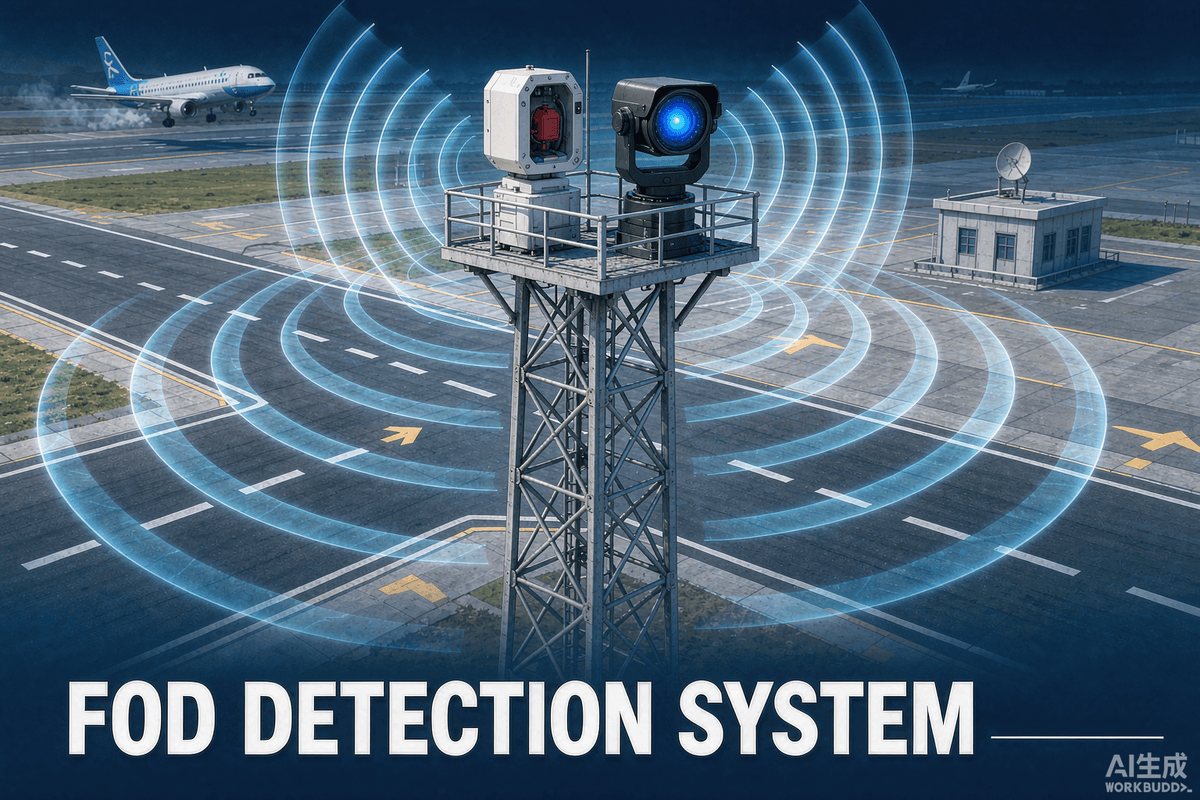
Figure 1: A tower-mounted FOD detection system combining millimeter-wave radar and high-definition night vision to scan an airport runway.
2. The Cost of Doing Nothing
Understanding the economics of FOD detection begins with understanding the cost of an engine ingestion event. A single FOD ingestion into a high-bypass turbofan engine can require a full engine teardown and overhaul, costing anywhere from $1 million to over $10 million depending on the damage. A blown tire from runway debris can reach $15,000 in direct replacement costs plus associated delays. When these events multiply across an airport's daily operations, the annual cost of manual, reactive FOD management quickly dwarfs the price of an automated detection system.
Traditional FOD management relies on periodic visual inspections — typically a runway sweep conducted on foot or by vehicle a few times per day, as required by regulation. The gap between inspections is precisely where risk lives: a single piece of debris can be deposited seconds after an inspection passes and remain on the runway through dozens of takeoffs and landings. Tower-mounted FOD detection closes this gap with continuous, 24/7 monitoring.
Beyond direct damage, FOD events carry operational consequences that are often undercounted: runway closures during debris search, aircraft go-arounds, gate congestion, and cascading schedule disruption across an airline's network. The true cost of a single FOD event, when measured in system-wide delay minutes and passenger inconvenience, frequently exceeds the direct repair bill. This is why forward-looking airports treat automated FOD detection as an insurance policy with a measurable return, rather than an optional expense.
Consider the arithmetic at a busy international hub. A single runway closure of just ten minutes during peak hours can delay dozens of aircraft and thousands of passengers, generating delay costs measured in the hundreds of thousands of dollars per incident. When a runway is closed for a manual debris sweep that would otherwise be unnecessary, the airport forfeits landing-slot capacity that cannot be recovered. Automated detection reduces both the frequency and the duration of such disruptions by pinpointing debris instantly, allowing the removal crew to proceed directly to the location rather than walking or driving the entire runway surface in search of an unconfirmed object.
3. What Is a Tower-Mounted FOD Detection System?
A tower-mounted FOD detection system is a fixed-installation solution in which radar and electro-optical sensors are mounted on dedicated towers positioned along the runway. Unlike mobile vehicle-mounted systems that patrol periodically, tower systems provide permanent, gap-free surveillance of the runway surface, integrating directly with the airport's security operations center for real-time detection, alarming, and response coordination.
The system is composed of three core subsystems. First, a millimeter-wave radar system performs continuous scanning of the runway surface, detecting the presence of foreign objects and measuring their distance and position. Second, a high-definition night-vision optical system provides visual verification and characterization of each detected object, allowing operators to confirm whether an alert is a genuine FOD item or a benign object such as a runway marking. Third, an integrated information display and control system presents all detections in a command-center platform, enabling real-time runway monitoring, foreign-body localization, and automated alarm management.
What distinguishes the tower-mounted approach from earlier generations of FOD technology is its permanence and its sensor fusion. Because the system is always on and always watching, it eliminates the coverage gaps inherent in periodic inspection. And because radar and optics work together rather than independently, it combines radar's all-weather reliability with the human operator's need for visual confirmation — a combination that has proven decisive in real airport deployments.
4. How the Detection Technology Works
At the heart of the tower-mounted system is a hybrid sensor architecture that fuses millimeter-wave radar with optical verification. This hybrid approach is the industry's answer to the fundamental weakness of single-technology systems: cameras alone fail in darkness, fog, rain, and snow, while radar alone cannot visually confirm what it has detected.
The millimeter-wave radar continuously transmits and receives signals across the runway, detecting even tiny metallic and non-metallic objects by their radar cross-section. When the radar identifies a candidate object, the system automatically slews the optical camera to the object's coordinates, captures a high-resolution image, and displays it to the operator. This closed-loop workflow — radar detects, optics confirm, human decides — produces a system with an exceptionally low false-alarm rate of fewer than one per day, even under continuous 24-hour operation.
The system works through a defined workflow: the radar detects a potential FOD, the optical device is automatically called to the location, video is captured, the object is classified as FOD or non-FOD, and confirmed FOD is reported to the central control system for dispatch of a removal team. Non-foreign objects are logged and monitoring continues uninterrupted.

Figure 2: Common FOD test specimens used to validate detection performance, including metal cylinders, a golf ball, nuts, and runway light parts.
5. Key Technical Specifications
For airport oper
ators evaluating a tower-mounted FOD system, the following specifications are the critical decision criteria. Haisen Global's fixed tower system delivers industry-leading performance across each parameter.
Table 1: Key technical specifications of the tower-mounted FOD detection system
6. System Architecture and Components
A complete tower-mounted FOD detection system is more than a single sensor. It is a distributed network of detection nodes, power supplies, data transmission infrastructure, and management software, all engineered for continuous, reliable operation in a harsh airfield environment.
Each detection node integrates a millimeter-wave radar (the TADARF radar) with an optical transponder for visual verification. These nodes connect over high-speed optical switching equipment to a central server and graphics workstation in the control center, forming a resilient network that spans the full runway length. The supporting infrastructure includes the tower and cement base, fiber-optic cabling, and a UPS power supply to ensure uninterrupted operation during power fluctuations.
The FOD information management software is the system's brain. It provides three core functions: FOD information management (tracking every detection from alert to resolution), detection data statistical analysis (generating heat maps of FOD distribution, density, and trends), and FOD business process management (orchestrating the workflow from detection through removal and closure). This software converts raw sensor data into actionable operational intelligence.
7. FOD Information Management Software
The value of a detection system is only realized when operators can act on its output quickly and confidently. Haisen Global's management software is designed around this principle, with a data statistics interface that displays a heat map marking the distribution and density of foreign objects across the entirety of the runway. Operators can screen objects by time, foreign-body type, threat level, and treatment batch, and export filtered results as Excel sheets for regulatory reporting and trend analysis.
The software also provides historical data query capabilities that show the quantity and proportion of different foreign-object types, the distribution of risk levels, and monthly counts of each object category. This longitudinal view is invaluable for identifying recurring FOD sources — for example, a particular gate area that consistently produces metal fragments — and targeting preventive measures.
For field operations, a mobile version of the management software runs on handheld devices. When FOD is confirmed, the object information is pushed to the dedicated local area network, and a task notification is sent to on-site personnel. The mobile app automatically guides field staff to the foreign object's location via self-navigation, allowing them to perform secondary confirmation, take on-site photos, dispose of the object, and upload the photographic evidence back to the system. This closed-loop, fully documented process is what distinguishes an integrated FOD management platform from a simple alarm device.
8. Tower-Mounted vs. Mobile FOD Detection
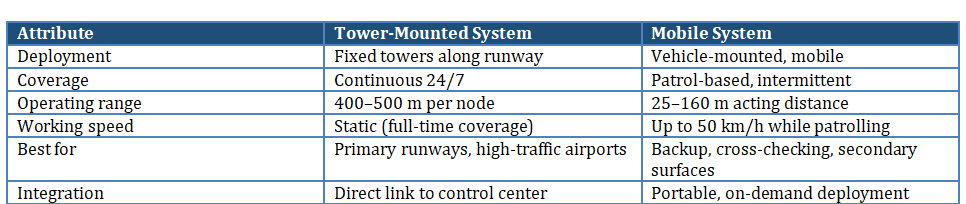
Table 2: Tower-mounted vs. mobile FOD detection systems
In practice, leading airports deploy tower-mounted systems on their primary runways for continuous protection and use mobile systems as a flexible supplement for taxiways, aprons, and rapid response verification. Both variants share the same core detection performance: 1.5 cm minimum detectable object and fewer than one false alarm per day. The mobile system's operation interface integrates a GPS mobile station and RTK base station for precise positioning, a lift platform for sensor elevation, and a DC-to-AC converter for power flexibility.
9. Deployment Strategy and Coverage Planning
Effective deployment is as important as the technology itself. After comprehensive evaluation of safety requirements, radar performance, optical lens capabilities, and cost-effectiveness, the optimal deployment places each detection node to cover a 400-meter runway segment. For a standard E-grade runway measuring 3,000 meters by 60 meters, this translates to eight detection systems providing complete coverage.
Positioning is governed by aviation safety standards and electromagnetic compatibility requirements. The optimal tower location is 160 to 210 meters from the runway centerline, with an ideal mounting height of 6 to 8 meters. This placement ensures the sensors have an unobstructed view of the runway while remaining clear of aircraft movement areas and avoiding interference with air traffic control, navigation, and surveillance equipment. Critically, the system's obstacle assessment confirms it does not affect flight safety, and electromagnetic environment analysis verifies zero impact on airport communication and navigation systems — the equipment operates normally even during aircraft takeoff and landing.
10. Detection Performance and Test Validation
Before any FOD system is accepted for operational use, it must prove its detection capability against a standardized set of test specimens. Haisen Global validates its systems against twelve representative FOD types: metal cylinders of varying diameters (15, 20, 25, 30, and 38 mm), a white golf ball, a spanner, a fabric jacket, tire rubber fragments, metal strips, nuts, hydraulic tubing, white polyethylene tubing, a vehicle fuel-tank cover, cement concrete fragments, and runway lighting parts.
The system's ability to detect these objects — in all weather conditions including daytime, dusk, night, rain, fog, and snow — has been confirmed through demonstration programs at multiple major Chinese airports, including Shanghai Pudong International Airport, Guangzhou Baiyun International Airport, Yulin Airport in Shaanxi Province, and Dazhou Airport in Sichuan Province. Actual operational data confirms that the system meets the FOD detection requirements specified by the Civil Aviation Administration of China (CAAC), with several core indicators exceeding the technical standard.
11. The Business Case and ROI
The return on investment for a tower-mounted FOD detection system is driven by four factors. First, avoided engine damage: even one prevented ingestion event can exceed the cost of the entire detection system. Second, reduced flight disruption: rapid FOD identification and removal minimize runway closure time and flight delays. Third, regulatory compliance: automated detection supports compliance with FOD management programs required by aviation authorities. Fourth, operational efficiency: continuous monitoring replaces labor-intensive manual sweeps and provides a documented, auditable safety record.
Airport operators increasingly view FOD detection not as an optional enhancement but as a core component of the smart-airport digital transformation. By feeding FOD detection data into a broader security situation-awareness platform, airports gain a unified view of runway safety alongside bird-strike prevention and low-altitude air-defense subsystems. This integrated approach aligns with the aviation industry's broader shift toward data-driven, sensor-fused airport operations.
This integration matters because the threats an airport faces do not operate in isolation. FOD on the runway, birds in the approach path, and low-altitude airspace intrusions are all facets of the same operational challenge: protecting the aircraft movement area. An airport security situation-awareness platform that unifies the FOD detection subsystem, the bird detection and repelling subsystem, and the low-altitude air defense subsystem into a single command-and-control picture enables a coordinated, holistic response that fragmented point solutions cannot deliver. For airports pursuing digital transformation, the FOD detection system is therefore not merely a safety device — it is a data source feeding the airport's broader operational intelligence, informing everything from runway maintenance scheduling to long-term infrastructure planning.
12. Regulatory and Standards Context
FOD management is governed by international and national standards. The International Civil Aviation Organization (ICAO) requires airports to establish a FOD management program as part of their aerodrome safety management system. In the United States, FAA Advisory Circular AC 150/5220-24 provides guidance on FOD detection equipment, while in China, the CAAC sets technical standards for FOD detection systems. A tower-mounted system that has passed CAAC testing — as Haisen Global's has — provides a strong foundation for acceptance in other regulatory jurisdictions, subject to local certification requirements.
For airport operators navigating multi-jurisdiction compliance, it is important to recognize that while standards converge on core principles, specific technical thresholds and certification processes differ. Engaging a vendor with proven certification history and the capacity to support local homologation is therefore a critical selection criterion. Haisen Global's experience across multiple regulatory environments positions it to assist airports in aligning their FOD management programs with applicable requirements.
13. Selecting a FOD Detection Vendor: An Evaluation Checklist
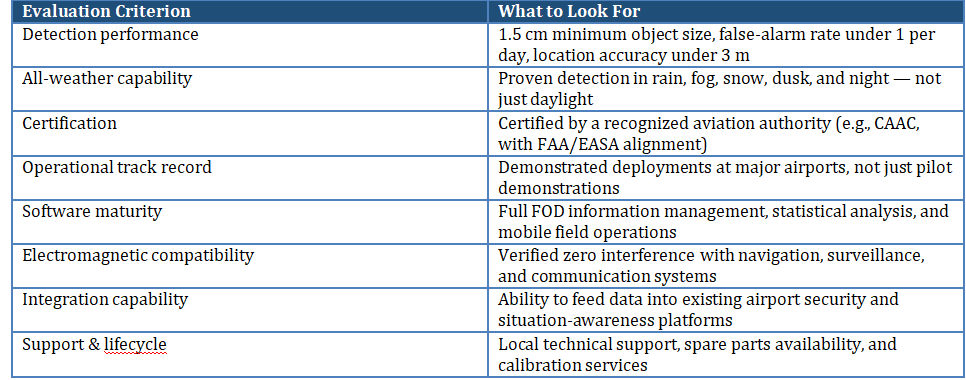
A vendor that can demonstrate all eight criteria — with verifiable case studies and certification documents — de-risks what is otherwise a high-stakes procurement. Haisen Global encourages airports to benchmark any shortlisted system against this checklist and to request reference-site visits where possible.
14. Frequently Asked Questions
Q: What is the minimum size of FOD that a tower-mounted system can detect?
A: A high-performance tower-mou
nted FOD detection system can detect objects as small as 1.5 cm in diameter by 1.5 cm in height. This threshold captures the small fasteners, nuts, bolts, and metal fragments that pose the greatest engine-ingestion risk, while filtering out harmless surface texture.
Q: How does tower-mounted FOD detection differ from camera-only systems?
A: Camera-only systems perform well in daylight but degrade in darkness, fog, rain, and snow. A tower-mounted hybrid system fuses millimeter-wave radar (which operates reliably in all weather and lighting) with optical verification, delivering true 24/7 detection. The radar detects and localizes the object, and the camera confirms and characterizes it, producing a very low false-alarm rate.
Q: How many FOD detection systems does a runway need?
A: Coverage planning depends on runway length. With each tower-mounted node covering 400 to 500 meters, a standard 3,000-meter runway requires approximately eight detection systems. Systems are positioned 160 to 210 meters from the runway centerline at a height of 6 to 8 meters.
Q: What is an acceptable false-alarm rate for an FOD detection system?
A: A leading tower-mounted FOD system should maintain a false-alarm rate of fewer than one per day. Excessive false alarms cause operator alarm fatigue and undermine trust in the system. Haisen Global's hybrid radar-plus-optical architecture achieves this through automatic optical confirmation of every radar detection.
Q: Can the system operate in extreme weather conditions?
A: Yes. The system is rated for continuous 24-hour operation across a temperature range of −35°C to +65°C and has been validated for detection in rain, fog, and snow. Its all-weather capability is a key advantage over camera-based systems that lose effectiveness in low-light and adverse conditions.
Q: Does the FOD detection system interfere with airport navigation equipment?
A: No. Electromagnetic environment analysis confirms that the system does not affect airport communication, navigation, or surveillance equipment. The system has passed obstacle assessment (no impact on flight safety) and operates normally during aircraft takeoff and landing.
Q: What types of FOD can the system detect?
A: The system is validated against twelve representative FOD categories: metal cylinders (15–38 mm), golf balls, spanners, fabric items, tire rubber fragments, metal strips, nuts, hydraulic tubing, polyethylene tubing, fuel-tank covers, cement concrete fragments, and runway lighting parts. It detects both metallic and non-metallic objects, which is a key advantage of millimeter-wave radar over purely magnetic or visual systems.
Q: How does the system handle false alarms caused by runway markings or surface texture?
A: Every radar detection is automatically verified by the high-definition optical camera before an alert is raised. This radar-plus-optical confirmation loop filters out benign objects such as runway markings, surface stains, and other harmless features, keeping the false-alarm rate below one per day. Operators can further confirm each alert visually in the command center before dispatching a removal crew.
15. Conclusion
Foreign Object Debris remains one of aviation's most persistent and costly threats, but it is also one of the most preventable. Tower-mounted FOD detection systems replace the blind spots of periodic manual inspection with continuous, all-weather surveillance that detects a 1.5-centimeter object, alerts the control center in seconds, and guides a removal crew to within three meters of the debris.
For airport operators pursuing both safety and digital transformation, the tower-mounted FOD detection system is a foundational investment: it protects aircraft and passengers today, while providing the data foundation for tomorrow's smart airport. With proven deployments at major Chinese airports and formal CAAC certification, Haisen Global's system delivers the performance, reliability, and regulatory credibility that international airports require.
To learn how a tower-mounted FOD detection system can be tailored to your runway configuration, contact Haisen Global for a technical consultation and deployment plan.