
A parameter-by-parameter engineering comparison, using the BHM02 trailer platform as the reference case — including an honest answer to the question most suppliers avoid: when does the conversion actually pay?
Electrifying a runway friction tester does not change what the instrument measures. The 15 % slip ratio, the 1 mm × 10 mm water film, the 4.00-8 test tyre and the µ value compared against a regulatory threshold all stay the same. What changes is where the energy comes from, how much the trailer weighs, how much switching noise sits next to a two-microvolt load-cell signal, and which approvals have to be re-opened. On a towed platform such as the BHM02, the energy saving is in the region of a few hundred euros a year. The real drivers are emissions rules, night noise, hangar operation and tender scoring — not fuel cost.
1. Why this question is being asked now
Runway friction measurement has always been a low-utilisation asset. A busy international airport runs a friction survey weekly in wet season and monthly in dry season; a regional airport may run four a year. A trailer-type tester therefore spends most of its life parked, and the diesel engine that motivates most electrification business cases — the engine that idles all day in a bus or a container handler — simply is not there. The energy that a friction tester consumes is dominated by the vehicle that tows it, not by the instrument itself.
Yet the question keeps arriving, and for good reasons that have nothing to do with fuel. Airports in Europe and the Gulf are writing ground support equipment (GSE) electrification targets into their concession agreements and into their capital plans. Night-time noise limits around residential approaches make a diesel tow vehicle an awkward companion for a 02:00 survey. Maintenance hangars and covered test facilities cannot run a diesel unit indoors at all. And an increasing number of public tenders score the bidder on the emissions of the equipment being supplied, which turns a powertrain decision into a scoring decision.
There is also a technical reason to look again. Modern variable-frequency drives and permanent-magnet motors give speed control that is, in several respects, better than a mechanical driveline: no torque converter slip, no gearshift shock, and the ability to hold 65.0 km/h on a wet runway with less than a tenth of a percent of speed ripple. Since friction coefficient is measured in a narrow band around ±0.02, anything that steadies the test speed is worth understanding.
So the useful question is not "is electric better?" It is: which parts of the measurement chain are sensitive to electrification, and which are indifferent? This article answers that question with numbers taken from the BHM02 platform documentation rather than with marketing language.
2. What the instrument actually measures — and what electrification cannot touch
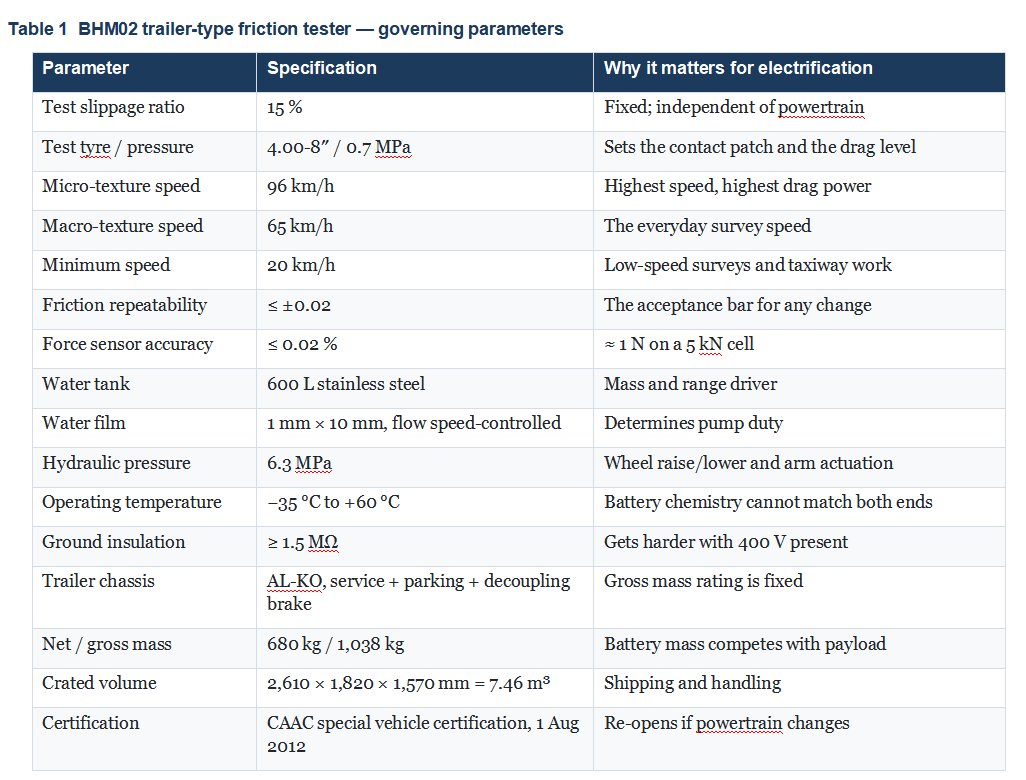
A runway friction tester is a drag-measuring instrument disguised as a trailer. A small test wheel, braked to a fixed slip ratio of 15 %, is pressed against the runway at a controlled tyre pressure of 0.7 MPa and towed along the centreline at a defined speed. Two load cells resolve the force system: a vertical cell rated at 500 kg measures the wheel load, and a horizontal cell rated at 5 kN measures the drag. The friction coefficient µ is the ratio of the two. Everything else in the machine — the chassis, the water system, the computer, the printer — exists to make that ratio repeatable and traceable.
That definition fixes a set of physical invariants. Electrification does not move them:
· The slip ratio stays at 15 %, because the regulatory comparison depends on a fixed-slip measurement; a free-rolling or variable-slip wheel measures a different quantity.
· The water film stays at 1 mm thick by 10 mm wide ahead of the test wheel, because film thickness is part of the test condition, not a machine preference.
· The test tyre stays 4.00-8, because changing the contact patch changes the drainage regime and therefore the µ value at a given speed.
· The measuring speeds stay at 96 km/h for micro-texture, 65 km/h for macro-texture and a 20 km/h minimum, because the speed ladder itself is the diagnostic tool.
· The reported quantity stays the friction coefficient, compared against the airport operator's threshold for the reported runway surface condition.
The measurement chain, in numbers
It helps to follow the signal path, because this is where electrification can quietly do damage. The load cells are wired as strain-gauge bridges, excited at a few volts. A typical 2 mV/V cell therefore delivers about 10 mV at full scale. The stated force-sensor accuracy of 0.02 % of full scale corresponds to roughly 2 µV on that signal — about the same order as the thermal drift of a connector. The Flintec LAC74.1 transmitter specified on the BHM02 resolves better than 0.5 µV, which is the headroom that makes a ±0.02 friction reading achievable in the first place.
Sample that chain at 10 kS/s, as the NI USB-6001 acquisition card does, and you have enough data to average away random noise. What you cannot average away is coherent interference at the switching frequency of a motor drive. This single fact governs most of the engineering that follows in section 5.
3. Where the energy actually goes
In a towed tester, the tow vehicle supplies propulsion; the trailer supplies measurement. The trailer loads are modest: a water pump, a hydraulic power pack for the wheel lift and measuring arm, the industrial computer, the acquisition electronics and a thermal printer. On the BHM02 those loads are fed from the tow vehicle through a single signal and power cable, which is also why the platform has no engine of its own to replace.
The water system is easy to size from first principles, and the result is counter-intuitive. The film is 1 mm thick and 10 mm wide, so its cross-section is 10 mm². Volume flow is therefore Q = A × v, which gives 10.8 L/min at 65 km/h and 16.0 L/min at 96 km/h. A 600 L tank therefore covers about 60 km of continuous film — and that figure is independent of speed, because flow and speed rise together. Sixty kilometres is roughly eight full passes of a 3,000 m runway plus repositioning, which is why the tank is sized at 600 L rather than 200 L.
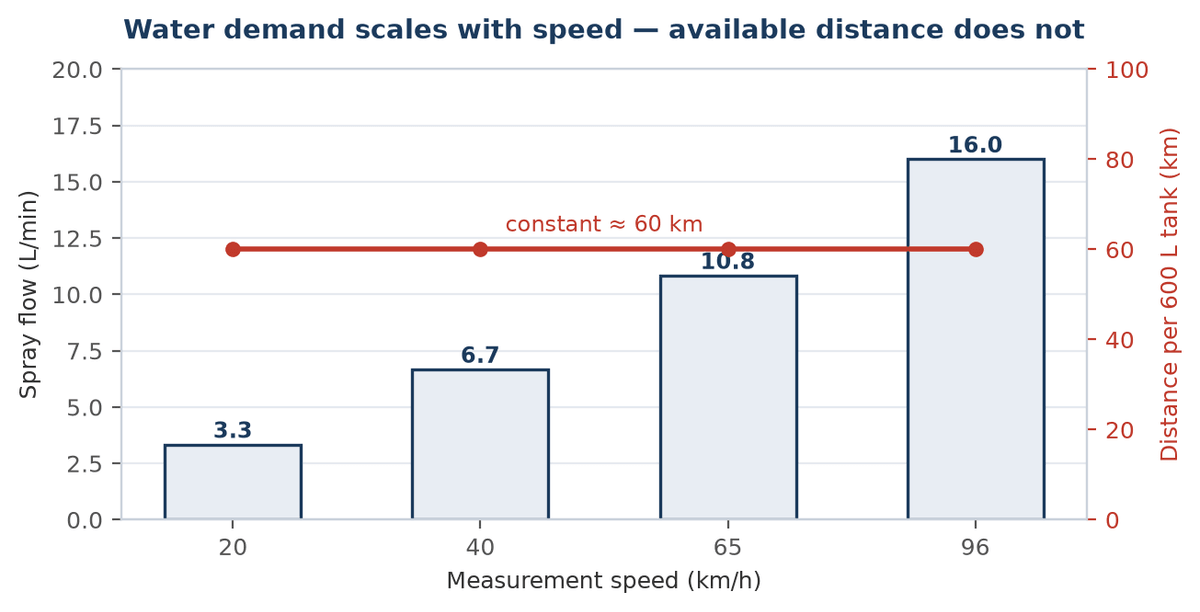
Figure 1 Spray demand rises with speed, but the distance available from a 600 L tank stays at about 60 km. Derived from the 1 mm × 10 mm film geometry specified for the BHM02.
The pump is specified at a maximum of 260 L/min, an order of magnitude above steady-state demand. That looks like oversizing until you consider what the pump is actually for: establishing the film within a few metres of the start line, re-establishing it after a stop, and covering transients when the driver accelerates to survey speed. Peak flow is a transient capability, not a continuous rating, and any electrification study that sizes a battery from 260 L/min will over-specify the pack by a wide margin.
The same logic applies to the hydraulic system. The 6.3 MPa circuit raises and lowers the test wheel and actuates the measuring arm. It runs for seconds per survey, not minutes. Replacing the engine-driven pump with a small electric power pack changes the weight and the wiring, not the energy budget.
The conclusion is uncomfortable for anyone hoping to justify a conversion on efficiency grounds: on a towed friction tester, the trailer is not where the energy is. If you want to reduce diesel consumption, you are really talking about the tow vehicle — and that is a fleet decision, not an instrument decision.
4. Three scopes of electrification, and what each one changes
"Electrifying the friction tester" means three quite different projects depending on what is being converted. Conflating them is the most common source of bad specifications, because the costs and the re-approval burden differ by an order of magnitude.
Scope A — electric tow vehicle
The trailer is untouched; the pickup or SUV that tows it becomes battery-electric. This is the least invasive option and the one that delivers most of the emissions benefit, because the tow vehicle does the work. The engineering questions are range and payload rather than measurement integrity: a towing duty cycle typically doubles or triples consumption, and the BHM02 adds 680 kg plus tongue load. Nothing in the measurement chain changes, so no re-certification of the instrument is triggered.
Scope B — self-powered trailer
A battery pack and an electric hydraulic power pack are added to the trailer so it no longer depends on the tow vehicle for auxiliaries. This removes the umbilical cable, lets the trailer be repositioned and pre-checked without a running engine, and makes indoor and hangar work possible. It adds mass, it adds a charging routine, and — this is the part that matters — it puts a switching power converter within a metre of the load-cell cabling.
Scope C — integrated electric chassis
The tester becomes self-propelled on an electric light-truck chassis. This is a different product, not a converted one. It eliminates the tow vehicle entirely, which is attractive where apron space is constrained, but it converts a 680 kg trailer into a multi-tonne vehicle, moves the measurement platform from a simple drawbar to a chassis, and re-opens crash, braking and electromagnetic compatibility approvals in full.
Table 2 What each scope of electrification touches
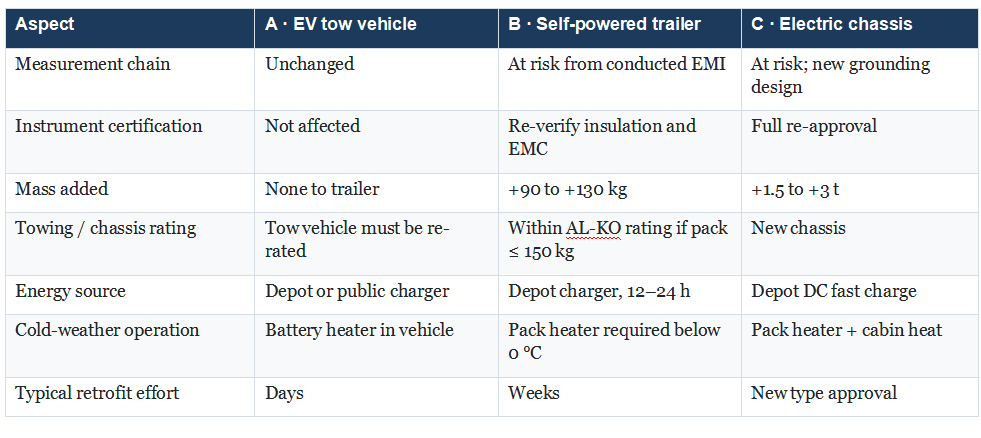
For most operators running a trailer-type tester, Scope A delivers the emissions and noise benefit at a fraction of the risk. Scope B is worth doing where hangar operation or cable-free positioning is a real operational need. Scope C is a fleet decision that should be evaluated as a new purchase.
5. The measurement chain: where electrification can hurt
This is the part of the discussion that gets skipped in sales literature, and it is the part that determines whether an electrified tester still meets its ±0.02 repeatability specification.
5.1 Conducted and radiated interference
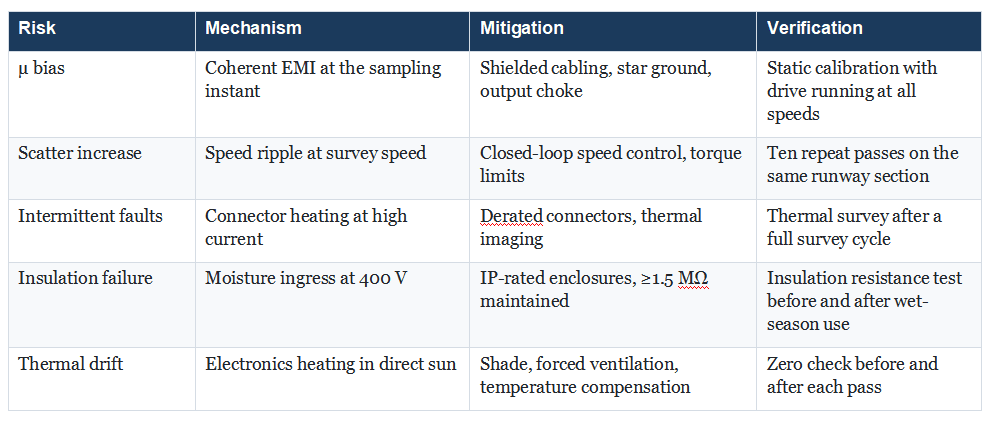
A motor inverter switches several hundred volts at 8 to 16 kHz with nanosecond-scale edges. The resulting common-mode current finds its way onto every cable that shares a ground path, including the load-cell cable. With a 2 µV signal of interest, even a few microvolts of coherent noise at the sampling instant is enough to bias the reading, and because the drive operates at a fixed switching frequency while the vehicle moves at a nearly constant speed, the interference is not random — it appears as a periodic offset that averaging cannot remove.
The countermeasures are well understood but must be designed in, not retrofitted: shielded twisted-pair cabling with the shield bonded at one end only; a single-point star ground with the measurement ground separated from the power ground; an LC or common-mode choke on the motor output; physically routing the load-cell cable away from the motor phase conductors; and synchronising the 10 kS/s acquisition to the drive switching window where the firmware allows it.
5.2 Speed stability — the one place electric wins outright
The friction coefficient is a function of slip, and slip depends on holding 65 km/h precisely. An electric driveline holds speed with a closed-loop controller that responds in milliseconds, without the torque-converter slip and gearshift transients of a diesel automatic. Field experience with electric GSE consistently shows lower speed ripple, which translates directly into lower scatter between passes. In other words, the powertrain change that threatens the electronics also improves the one variable the operator controls most directly.
5.3 Vibration and structural noise
Removing a diesel engine removes a broadband vibration source, which is good for the measuring arm. But an electric power pack still has a pump and a cooling fan, and a poorly isolated pack can introduce a narrow-band resonance that couples into the arm at exactly the wheel-pass frequency. Isolation mounts and a modal check of the arm assembly are cheap insurance.
Table 3 Risk register for an electrified measurement chain
6. The thermal envelope is where the comparison gets honest
The BHM02 is rated from −35 °C to +60 °C. That range is not decorative: the platform has been delivered to ten high-plateau airports at elevations up to 4,320 m, where a winter morning can start well below −20 °C, and to Gulf airports where a summer apron surface exceeds 60 °C. Any battery chemistry has to live inside that envelope, and none does so as comfortably as a diesel tank.
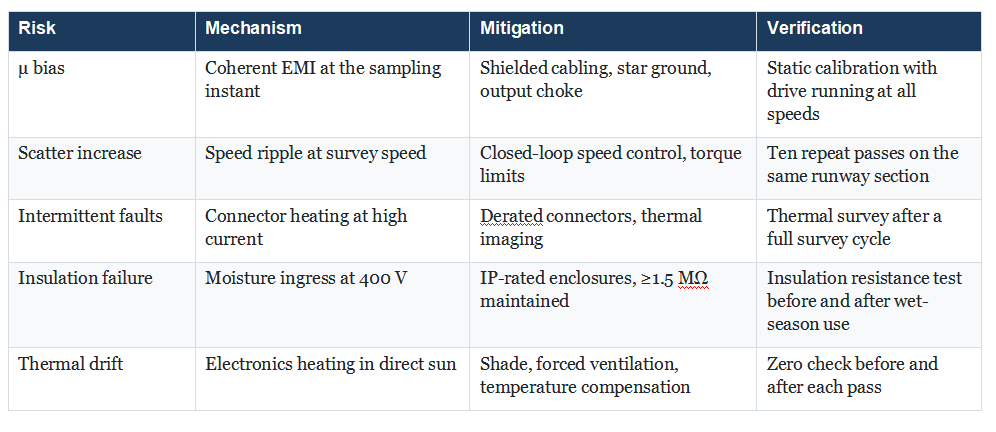
Figure 2 The rated operating range of the instrument against the practical charge and discharge windows of a lithium iron phosphate pack. The gap at the cold end is where diesel still wins.
Lithium iron phosphate cells discharge down to about −20 °C and charge only above 0 °C. Charging below freezing plates lithium and permanently reduces capacity, which is why every reputable pack refuses to charge when cold. A pack heater extends the charge window to about −20 °C, but the heater consumes energy from the same pack it is protecting, and at −35 °C the heater alone can absorb a significant share of the daily energy budget.
At the hot end the constraint is different. Above roughly 45 °C a pack must derate to avoid accelerated calendar ageing, and the pack sits on a trailer that may be parked on an apron at 60 °C. Forced ventilation or a shade cover is not cosmetic; it is a capacity decision.
The honest summary: an electrified friction tester is comfortable between about −10 °C and +45 °C, workable with a heater down to −25 °C, and genuinely compromised below −30 °C. If your survey calendar includes January mornings on a high-plateau runway, the diesel platform is still the lower-risk instrument — and saying so is more useful than pretending otherwise.
7. Mass, axle load and the shipping crate
Mass is the least discussed and most immediately consequential change. The BHM02 is 680 kg net and 1,038 kg in its export crate, with a crated volume of 7.46 m³. Adding a 10 kWh lithium iron phosphate pack at typical pack-level energy density adds roughly 95 kg including enclosure and BMS; an electric hydraulic power pack and a charger add perhaps another 35 kg net after removing the engine-driven components. The result is around 810 kg — a 19 % increase.
Nineteen per cent sounds modest until it meets a drawbar. Tongue weight scales with where the mass is placed, and the AL-KO chassis on the BHM02 is rated for a specific gross mass that cannot be exceeded by relocating components. The practical consequences are three: the pack must sit low and near the axle to avoid a tongue-weight increase, the tow vehicle must be re-checked against its braked towing rating rather than its unbraked one, and the export crate may need re-packing because the original 1,570 mm height was sized for the unmodified machine.
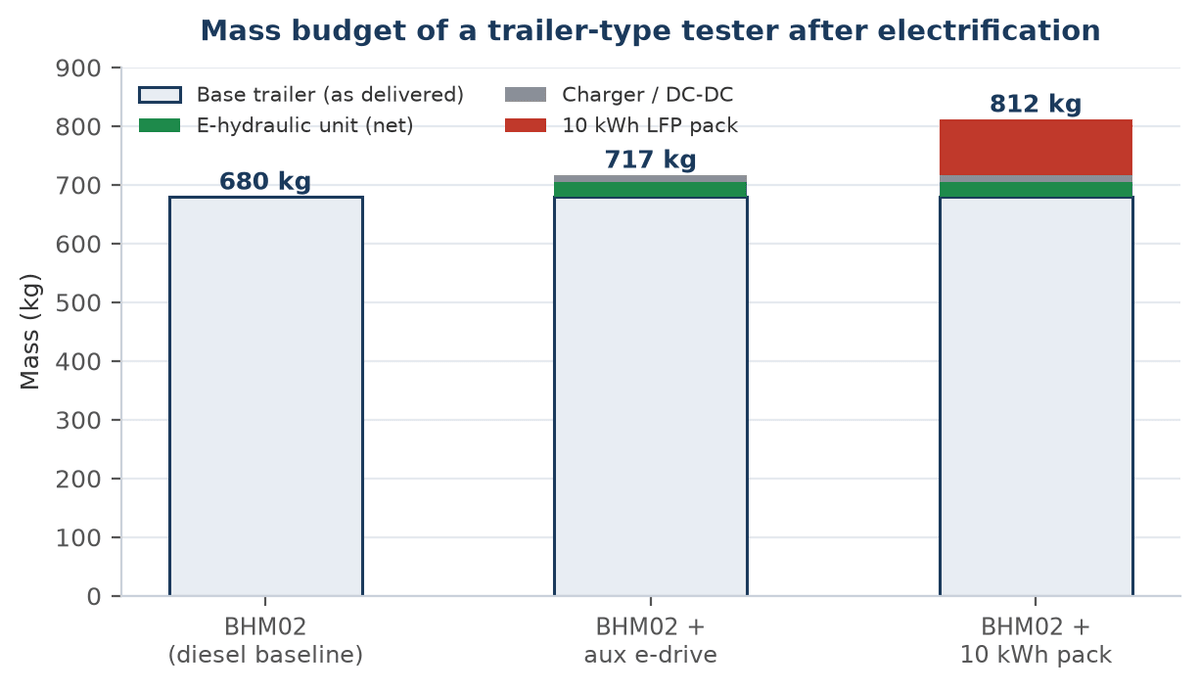
Figure 3 Mass budget for the BHM02 platform under two electrification scopes. The base trailer figure is the as-delivered net mass; the pack and power electronics are engineering estimates, not a product specification.
There is a quieter benefit on the other side of the ledger. Removing the diesel engine and its fuel tank removes a fire load and a set of consumables, simplifies the spare-parts list, and eliminates the fuel-storage question that appears whenever the tester is shipped by sea. For a unit that spends weeks in a container, that is not trivial.
8. The cost question, answered without optimism
Electrification business cases for GSE usually rely on fuel savings. For a friction tester, that arithmetic does not survive contact with the survey calendar, and it is better to say so plainly.
Take a mid-size airport running 120 surveys a year. A survey involves roughly 9 km of measurement driving plus 20 km of positioning, so about 29 km. A diesel tow vehicle at 12 L/100 km under towing load consumes about 3.5 L per survey; at €1.70 per litre that is about €6 per survey, or €715 a year. An electric tow vehicle at 0.30 kWh/km consumes about 8.7 kWh per survey; at €0.25 per kWh that is about €2.20, or €264 a year. The saving is roughly €450 a year.
Against that, an electric powertrain for a light commercial vehicle carries a capital premium in the order of €12,000 to €18,000, and a self-powered trailer conversion — pack, charger, e-hydraulic unit, EMC work, re-verification — lands in a similar range. On energy alone the payback period exceeds twenty years, which is longer than the asset life.
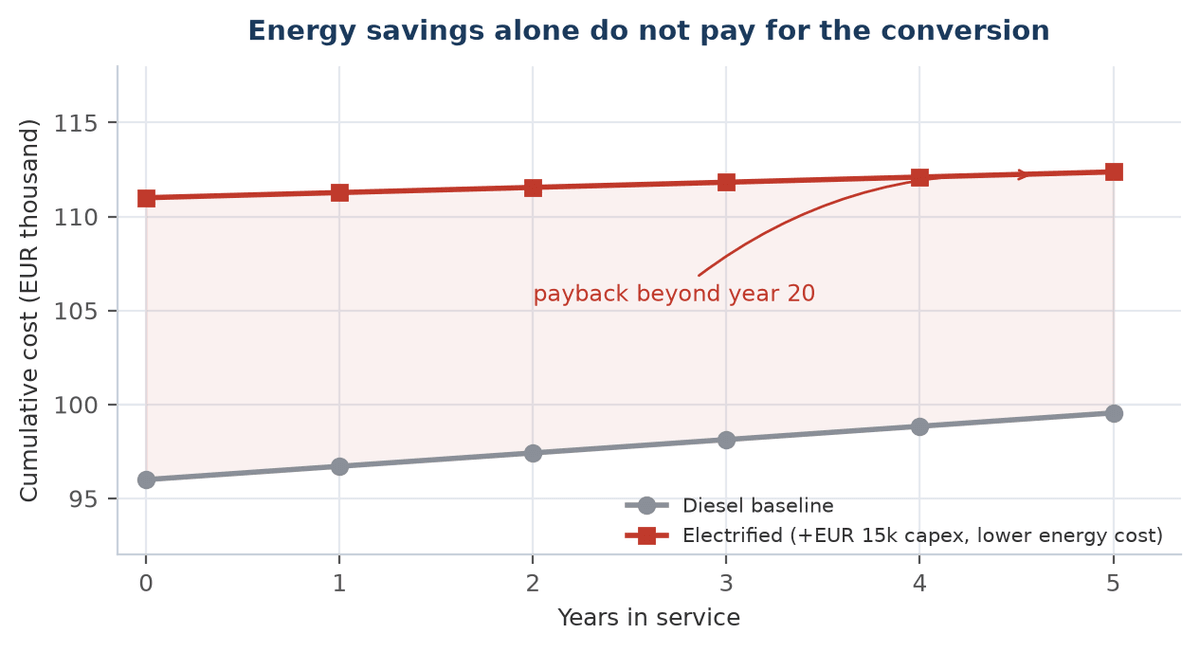
Figure 4 Cumulative cost of ownership under a fuel-savings-only business case. The conversion premium is not recovered by energy savings at realistic survey frequencies.
This does not mean the conversion is unjustified. It means the justification has to come from somewhere else, and the honest list is short: compliance with an airport electrification mandate; access to night-time slots where diesel is restricted; the ability to operate indoors; a tender scoring advantage worth more than the premium; or a corporate emissions commitment that is reported externally. If none of those applies, the rational decision is to keep the diesel platform and spend the money on calibration, training and survey frequency — which improve data quality far more than a powertrain change ever will.
9. When electrification is the wrong answer
There are configurations where a competent engineer should recommend against conversion, and it is worth naming them so that the recommendation carries weight when it is made.
· Low survey frequency. Below roughly forty surveys a year, the equipment is idle most of the time and the capital premium has no mechanism to return. Charging infrastructure that is used eight times a year is a liability, not an asset.
· Extreme cold calendars. If surveys routinely start below −30 °C, pack heating consumes the margin and the diesel platform remains the more reliable instrument.
· No charging point on the airside. Running a cable across an apron is not a solution; if the depot has no protected charging position, Scope B becomes an operational problem rather than a benefit.
· Certification freeze. If the instrument's approval is being used as a reference in an active tender or an authority audit, changing the powertrain mid-process re-opens a file that is better left closed.
· Dust-dominated environments. Fine dust plus forced-air cooling plus high-voltage electronics is a maintenance burden that outweighs the emissions benefit.
10. Certification: what actually has to be re-issued
This is the section where suppliers most often overstate their position, so it is worth being precise about what a certificate is and is not.
ICAO does not certify equipment. It publishes standards — Annex 14, Volume I, and the Airport Design Manual, Doc 9157 — and national civil aviation authorities verify conformity against those standards. The ICAO delegation in China has stated this position in writing: ICAO itself does not directly certify or issue qualification certificates for specific equipment, products or services; the relevant work is reviewed and certified by the civil aviation authority of the producing or user country. A supplier who claims an "ICAO certificate" for a friction tester is either confusing a standard with a certificate or repeating a translation error.
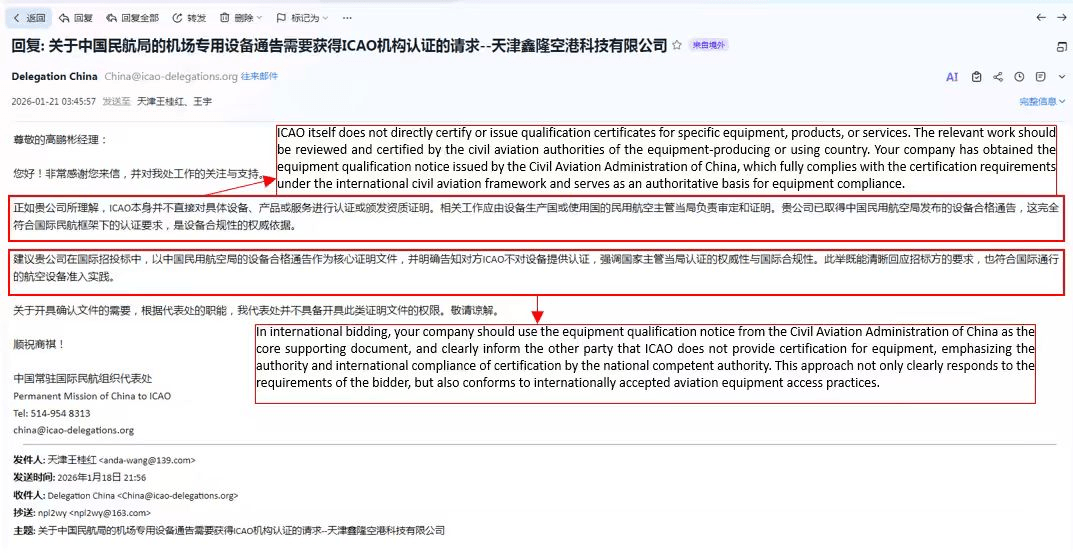
Figure 5 Written clarification from the ICAO delegation in China: ICAO does not certify individual equipment; conformity is verified by the national civil aviation authority. A procurement team that understands this asks for the right document.
The document that matters is the equipment qualification notice issued by the national authority. For the BHM02 that is the CAAC special vehicle certification issued on 1 August 2012 — the first trailer-type friction testing vehicle certificate issued in China. It is the document an airport procurement department should request, and the document that has to be revisited if the powertrain changes.
In practice, Scope A does not touch it at all. Scope B touches the electrical safety file — insulation resistance, protective earthing, battery enclosure rating — and may require an EMC declaration. Scope C requires a fresh type approval. Any supplier proposing a conversion should be able to state, in writing and before contract, which of these applies to their design.
Ask for the qualification notice, not for an "ICAO certificate". One exists; the other does not, and the answer tells you how well the supplier understands their own product.
11. A ten-question procurement checklist
These are the questions that separate a considered conversion from a repaint. They apply whether the conversion is done by the original manufacturer or by a third party.
1. What is the measured friction repeatability of the converted unit, and on how many passes was it demonstrated? A claim without a repeat test is an opinion.
2. How was the load-cell chain protected from inverter interference, and can you show the noise floor with the drive running?
3. What is the pack capacity in kWh, the usable depth of discharge, and the resulting number of runway passes per charge?
4. What is the pack mass, and where is it mounted relative to the axle? What is the resulting tongue weight?
5. What is the charge window, and what happens at −25 °C? Is a heater fitted, and what does it draw?
6. Does the gross mass stay within the AL-KO chassis rating, and is that stated in writing?
7. Which approvals change, and who owns the re-approval work — you or the buyer?
8. How is the water system sized, and does the pump still deliver the specified film at 96 km/h?
9. What is the maintenance interval for the drive and the pack, and which of those tasks can be done airside?
10. What happens to the calibration certificate after conversion — is the BHMBD01 procedure still valid, and is a fresh calibration traceable?
12. How Haisen approaches a conversion
Haisen builds and supports the BHM02 platform, and we are deliberately conservative about electrification. Our position is that a conversion should be offered only where the operational case is real, and that the measurement chain should be re-verified rather than assumed. In practice that means a repeatability test on the converted unit before it is shipped, a documented EMC check with the drive running, and an explicit statement of which approvals are unchanged and which are not.
Where the requirement is emissions or noise rather than an electric driveline for its own sake, we usually recommend starting with the tow vehicle — it delivers most of the benefit with none of the risk to the instrument. The BHM02 has been delivered to 293 airports, including nine 4F-class hubs, nineteen 4E airports and ten high-plateau airports, and the platform's value is that it keeps measuring the same way in all of them. Anything that changes that is a decision worth taking slowly.
Frequently asked questions
Does electrification change the friction coefficient a tester reports?
It should not, and if it does the conversion has failed. The friction coefficient is a physical property of the runway at a given slip ratio, film thickness and speed. Electrification changes the energy source and the mass distribution; it does not change the test condition. Any measurable shift in µ after conversion points to an interference, calibration or geometry problem that must be found before the unit is accepted.
Is an electric friction tester more accurate than a diesel one?
Not inherently. It can be more repeatable, because closed-loop electric speed control holds survey speed with less ripple than a diesel driveline, and because removing the engine removes a broadband vibration source. But it can also be less repeatable if the inverter noise is not dealt with. Accuracy is a property of the whole chain, not of the prime mover.
How much does the conversion cost, and what is the payback?
A tow-vehicle conversion carries a capital premium of roughly €12,000 to €18,000; a self-powered trailer conversion lands in a similar band once EMC work and re-verification are included. On energy savings alone — about €450 a year at 120 surveys — the payback exceeds twenty years. The case has to be made on compliance, noise access, indoor operation or tender scoring.
Can a diesel friction tester be retrofitted rather than replaced?
On a towed platform, yes for the auxiliary systems: a self-powered trailer conversion is a retrofit. Converting the trailer into a self-propelled electric vehicle is not a retrofit, it is a new product with new type approval. Operators should be clear about which of the two they are buying.
What happens to the CAAC certification after conversion?
A tow-vehicle change does not affect the instrument certificate. A self-powered trailer conversion may require re-verification of electrical safety and EMC. A chassis conversion requires fresh type approval. The qualification notice itself — the CAAC special vehicle certification issued to the BHM02 in August 2012 — is issued against a defined configuration, so any change to that configuration should be discussed with the authority before work starts.
Does ICAO certify friction testers?
No. ICAO publishes the standards — Annex 14 Volume I and Doc 9157 — and national authorities verify conformity. The ICAO delegation in China has confirmed in writing that ICAO does not issue qualification certificates for specific equipment. Buyers should request the national authority's equipment qualification notice instead.
At what temperature does an electric tester stop being practical?
Comfortably to about −10 °C; workable with a pack heater to about −25 °C; genuinely compromised below −30 °C, where heater draw consumes the energy margin. At the hot end, derating begins above roughly 45 °C ambient, which matters on a Gulf apron in summer.
Need a conversion assessed against your survey calendar?

Sources and further reading
ICAO Annex 14, Volume I — Aerodrome Design and Operations; ICAO Doc 9157, Aerodrome Design Manual, Part 4 (visual aids) and Part 3 (pavements), for continuous friction measuring equipment and reporting practice. CAAC special vehicle certification for the BHM02 trailer-type friction tester, issued 1 August 2012. Haisen Technology, BHM02 Measurement System Operation Manual, document HT-MN-202611-BHM02, Rev. 1.0. Haisen Technology quotation HT-QT-202611-002, 18 October 2026, for platform configuration, mass and shipping data. ICAO delegation in China, written clarification on equipment certification, January 2026. Figures 1 to 4 are derived by Haisen from the platform documentation; assumptions are stated in the text.
About the authors: this brief was prepared by the Haisen Technology engineering team and reviewed by Wang Guihong, General Manager. Haisen Technology manufactures and supports runway friction testing equipment and airport ground support equipment; the BHM02 platform has been delivered to 293 airports worldwide.