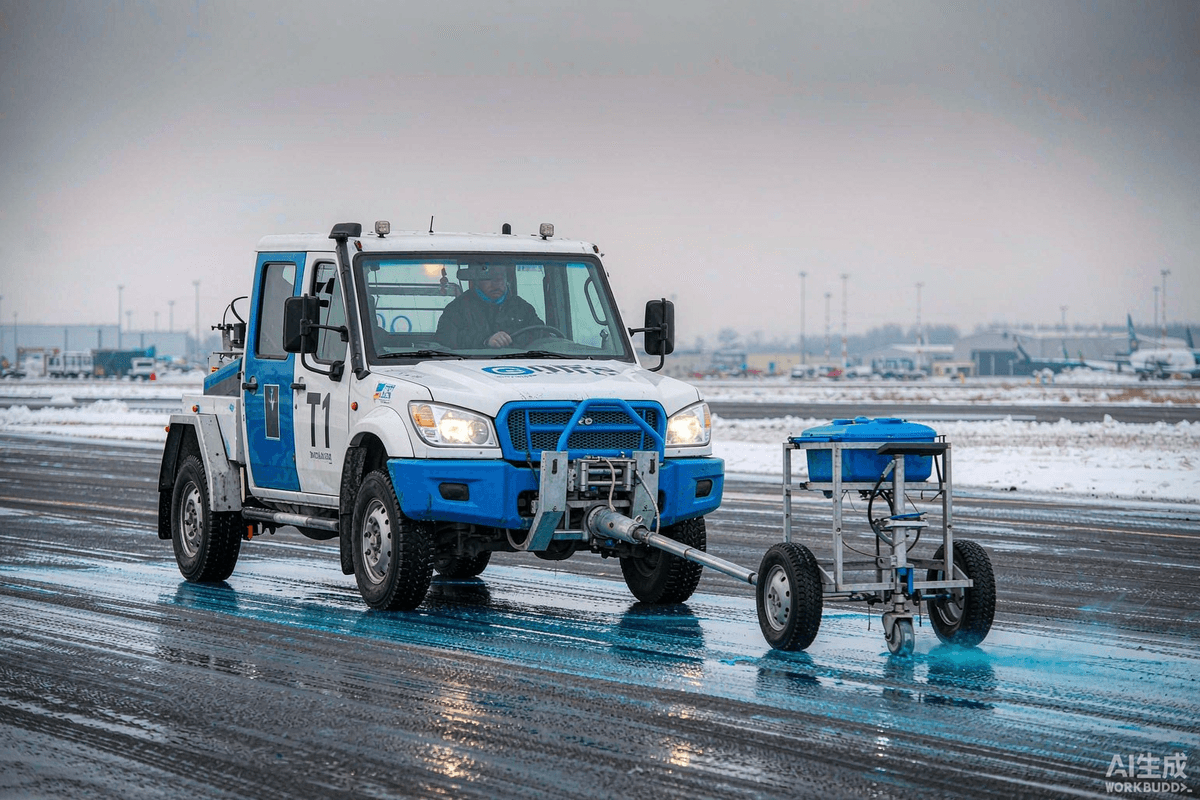
Figure 1 — A runway friction tester measuring friction on a wet, snow-contaminated runway during winter operations.
1. What Is a Runway Friction Tester?
A runway friction tester is a specialized vehicle or trailer that measures the coefficient of friction (μ) between an aircraft tire and the runway surface. By quantifying how much grip the pavement provides, it tells airport operators whether a runway is safe for take-off and landing — and, critically, how far that grip has been degraded by water, snow, ice, or rubber contamination.
A runway friction tester is a device that measures the coefficient of friction of an airport runway surface by driving a specially instrumented measuring wheel over the pavement and recording the ratio of horizontal tractive force to vertical load, producing a friction profile used to assess runway condition for safe aircraft operations.
Modern systems fall under the category of Continuous Friction Measuring Equipment (CFME): equipment that determines friction from the entire runway length rather than a few spot samples. This produces an accurate, location-resolved friction profile that reveals where the runway is losing grip — information that spot measurements cannot provide.
2. Why Runway Friction Matters
Friction is the physical mechanism by which an aircraft decelerates and steers on the ground. When friction drops, braking distances lengthen, directional control degrades, and the risk of a runway excursion rises sharply. Three failure modes dominate:
· Hydroplaning — a layer of water separates the tire from the pavement, eliminating braking entirely. Dynamic hydroplaning can begin at speeds as low as roughly 9 × √(tire pressure in psi) knots.
· Contaminated surfaces — compacted snow, ice, slush, and standing water dramatically reduce μ, especially when not reported accurately to flight crews.
· Rubber accumulation — landing gear deposits rubber on the touchdown zone over time, which seals the pavement and makes it dangerously slick when wet.
Runway excursions — aircraft running off the side or end of the runway — remain a leading category of serious aviation accident. Many occur on contaminated runways during landing or rejected take-off, precisely the scenarios where accurate friction information is most needed. This is why regulators require both routine and winter friction surveys, and why the results must be communicated to pilots in a standardized, unambiguous way.
Hydroplaning is not a single phenomenon. Dynamic hydroplaning occurs at higher speeds when a wedge of water builds under the tire and lifts it fully off the surface; viscous hydroplaning can occur even at low speed on a smooth, wet, or contaminated surface when a thin fluid film prevents contact; and reverted-rubber hydroplaning — the most dangerous — happens when locked-wheel skidding generates steam that melts the tire rubber, leaving the aircraft sliding on a film of its own steam. All three are governed primarily by one controllable variable: the friction available between the tire and the runway.
The stakes are documented. Runway excursions remain one of the most frequent categories of commercial-aviation accident worldwide, and a large share occur in conditions of standing water, snow, ice, or slush — precisely the situations where a runway friction tester provides the objective data that a subjective 'braking action good' report cannot.
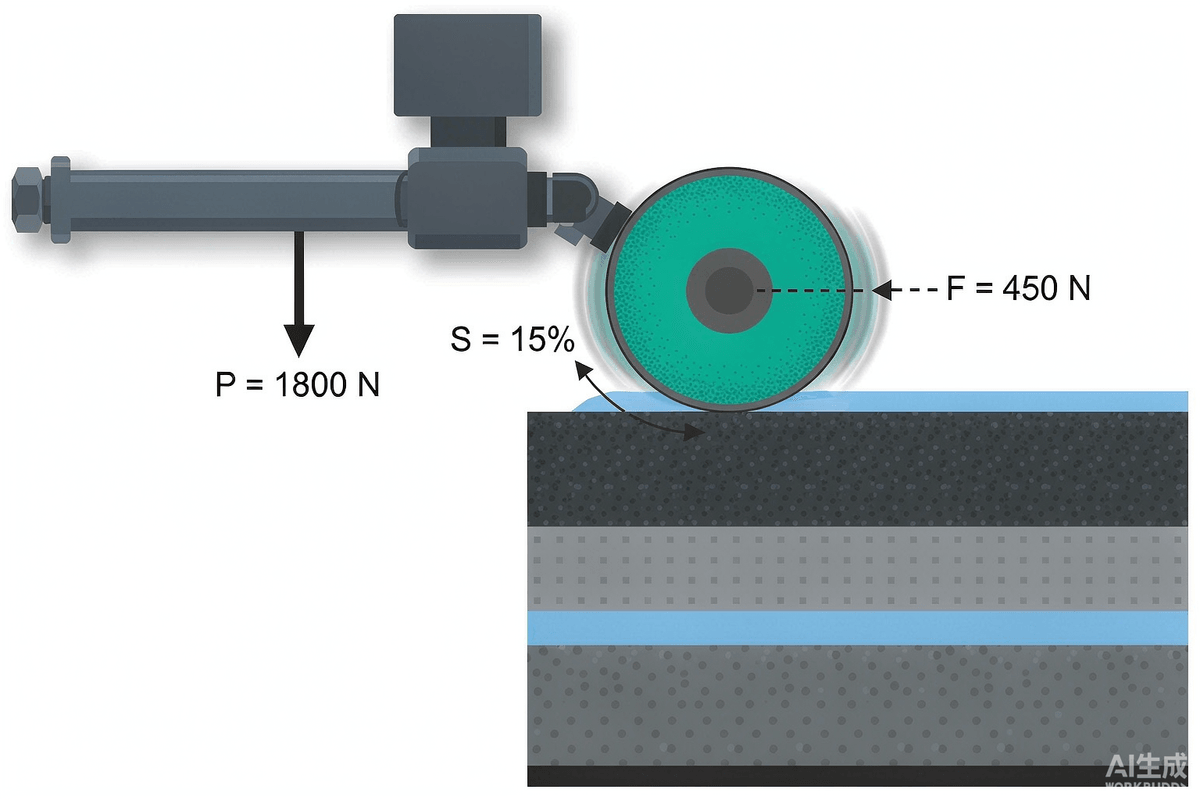
Figure 2 — The continuous friction measurement principle: a measuring wheel runs at a controlled slip ratio (≈15%) while force transducers record vertical load and horizontal tractive force, yielding μ = F/V.
3. How Friction Is Measured: The Continuous Principle
The coefficient of frictio
n is defined as the ratio of the horizontal force resisting motion to the vertical load pressing the surfaces together: μ = F / V. On a runway friction tester, a dedicated measuring wheel is lowered onto the pavement and driven at a controlled slip — typically about 15% — while a force transducer measures the vertical load and the horizontal tractive force in real time.
The 'continuous' in CFME refers to the fact that measurements are taken along the whole runway at speed, typically up to 96 km/h (about 60 mph), rather than at discrete points. This matters because runway friction is not uniform: it varies along the length and across the width of the runway, and only a continuous profile captures that variation. A self-wetting system sprays a precisely metered water film (typically 0.5–1.0 mm) onto the surface during testing, per ICAO wet-testing protocols, so that friction is evaluated under the worst-case wet condition that best predicts loss of control.
Test speed is standardized for good reason. ICAO wet-friction testing is performed at 65 km/h because it approximates the critical speed regime for landing and rejected-take-off decisions; measurements taken at other speeds are corrected or reported separately. The standardized water depth is equally important — too little water under-reports the hazard, while too much can induce hydroplaning that invalidates the measurement. Adhering to these controlled conditions is what makes a friction number comparable across airports and over time.
4. Types of Runway Friction Testers
The friction-tester market se
gments into three principal equipment categories, each suited to a different operational profile and budget:
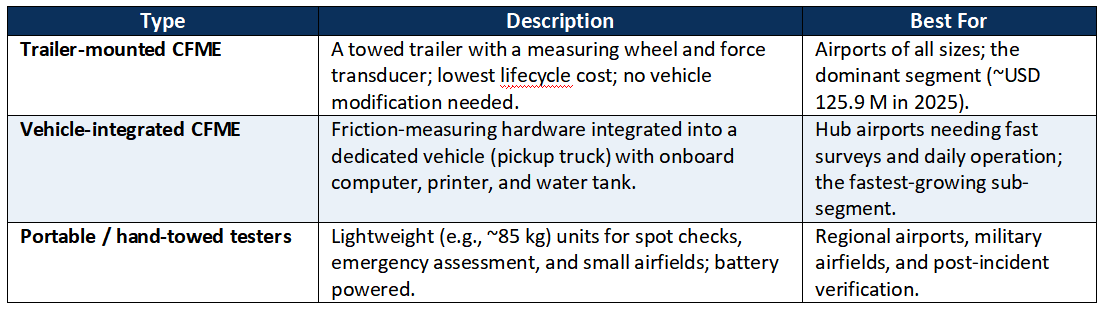
Whatever the form factor, all systems share the same core instrumentation: a measuring wheel, a force transducer, speed and distance logging, a self-wetting option, and software that outputs μ values in ICAO or FAA format with GPS tagging.
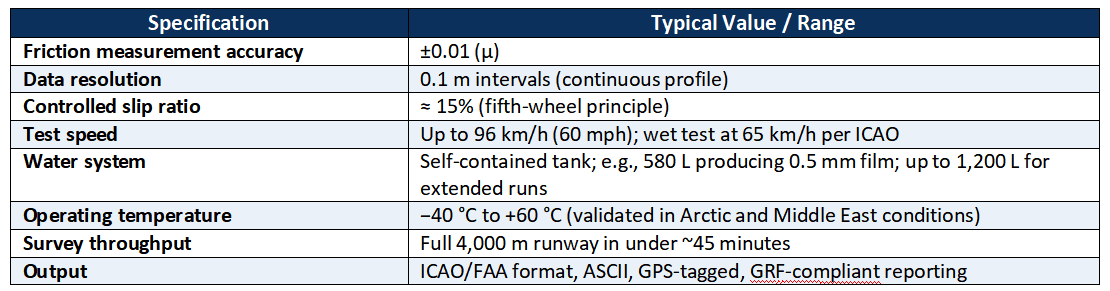
5. Key Technical Specifications
When evaluating a friction tester, the following specifications determine its accuracy, throughput, and operational envelope:
6. ICAO Standards and Friction Thresholds
The International Civil Aviation Organization provides the global regulatory backbone for runway friction through two documents: ICAO Annex 14, Volume I (Aerodrome Design and Operations) and the Airport Services Manual (Doc 9137, Part 2 — Pavement Surface Conditions). These mandate that paved runways be constructed and maintained with surface characteristics that provide minimum friction under all operational conditions.
The key thresholds, established through decades of accident analysis and engineering research, are:

Exact threshold values vary with the type of test equipment and test speed, which is why ICAO Doc 9137 requires airports to document which friction-measuring device was used. Testing frequency: runways serving jet aircraft should be surveyed at least annually, and industry analysis indicates 72% of hub airports (more than 100,000 movements per year) now test quarterly or monthly — a cadence the GRF mandate has accelerated.
These thresholds are not arbitrary. They emerged from decades of correlation between measured friction and actual aircraft braking performance, so that a reading below the maintenance planning level reliably predicts degraded stopping capability. Airports are therefore encouraged to establish their own friction-management policy — documenting trigger levels, test equipment, and response actions — within the ICAO framework, rather than treating the thresholds as isolated numbers.
7. The Global Reporting Format (GRF), RCAM, and RWYCC
Since its mandatory implementation in November 2021, ICAO's Global Reporting Format (GRF) has transformed how runway condition is reported. Instead of subjective descriptions, the GRF requires airports to assess and report runway conditions using a standardized Runway Condition Assessment Matrix (RCAM) expressed as a numerical Runway Condition Code (RWYCC) from 0 to 6.
Friction testers are the primary source of the objective friction data that feeds this matrix. A reported RWYCC is published to pilots via SNOWTAM and ATIS, giving flight crews a consistent, worldwide picture of runway braking action.
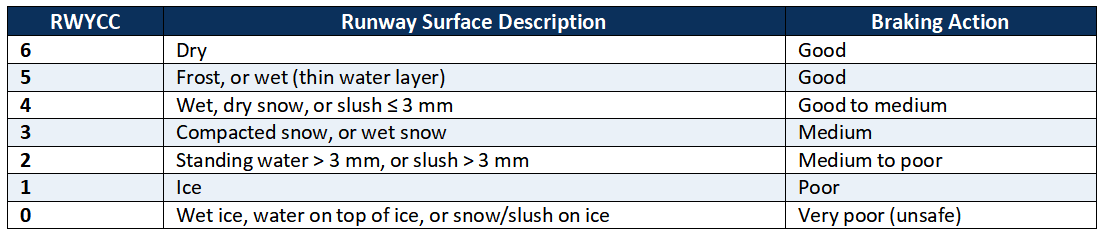
A critical compliance point: the GRF has effectively compressed equipment replacement cycles. Older friction measurement devices that lack digital output and integration capability cannot support GRF-compliant reporting, driving a technology-refresh cycle that favors modern, software-connected CFME.
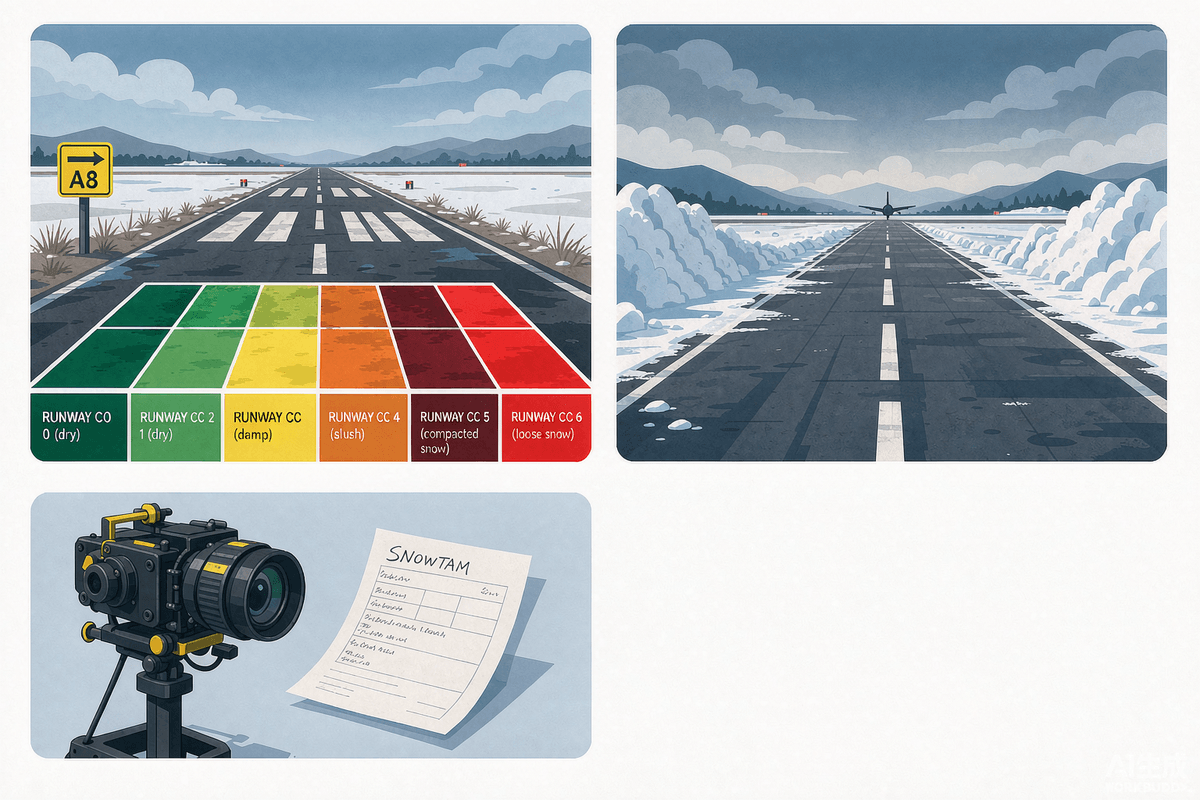
Figure 3 — The ICAO Global Reporting Format: runways are assessed in thirds using the Runway Condition Assessment Matrix, and results (RWYCC 0–6) are published via SNOWTAM and ATIS.
8. Testing Frequency and Best Practices
An effective friction-management program combines routine, seasonal, and event-driven testing:
· Routine/an
nual — at least one full-runway survey per year for runways serving jet aircraft (ICAO Doc 9137).
· Seasonal/winter — more frequent surveys during the winter season, triggered by snow, ice, or frost events.
· Event-driven — immediately after a significant contamination event, a reported braking-action concern, or an aircraft incident.
· Post-maintenance — after rubber removal, grooving, or resurfacing, to confirm the surface meets its design objective.
Best practice is to test in the direction and configuration that represents actual landing conditions, to maintain and calibrate the equipment on a documented schedule (top-tier systems need calibration only about once a year), and to feed every result into runway-condition software so that trends, not just snapshots, drive maintenance decisions.
9. Leading Runway Friction Testing Equipment
Several manufacturers dominate the global CFME market. Their systems share the continuous-measurement principle but differ in integration, throughput, and software ecosystem:
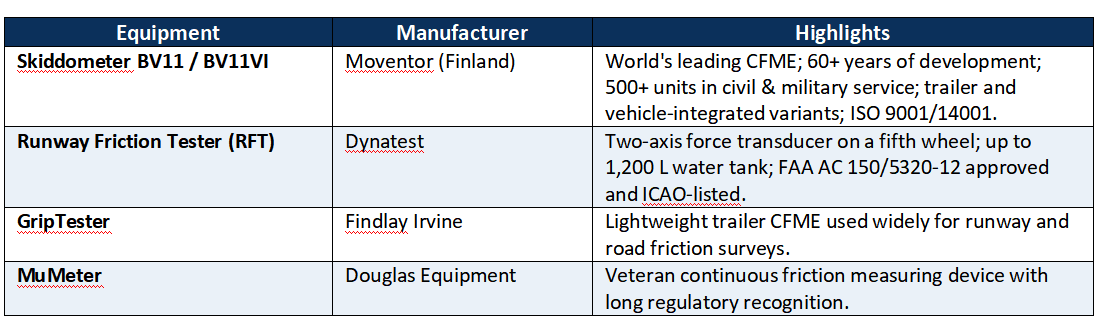
See the leading CFME in detail: Moventor Skiddometer BV11 and Dynatest RFT specifications.
Haisen Global's own BHM-series friction testers follow the same continuous-measurement principle — a vehicle-integrated CFME with 0.1 m resolution and ±0.01 accuracy, and a portable precision unit for regional and military airfields — delivering GRF-compliant output in both ICAO and FAA formats.
10. Market Size and Growth
The runway friction-tester market is expanding as GRF compliance becomes universal and airports shift from spot-check methods to continuous, data-driven monitoring. According to PW Consulting, the continuous friction measurement equipment market alone was valued at approximately USD 99.1 million in 2025, growing at a 7.21% CAGR, while the trailer-mounted CFME segment reached about USD 125.87 million in 2025 revenue.
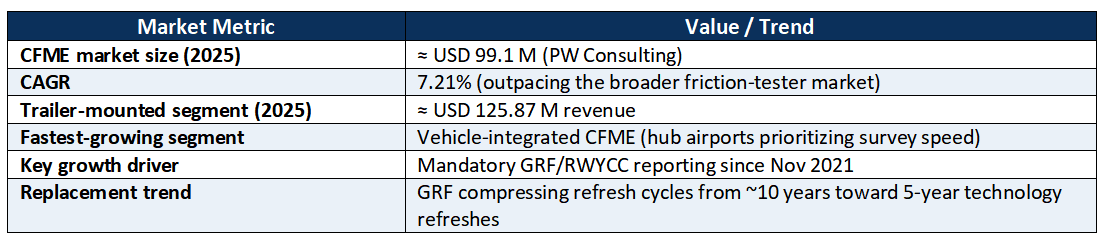
Sources: Haisen Global friction-tester market analysis; Airport Technology — Moventor CFME.
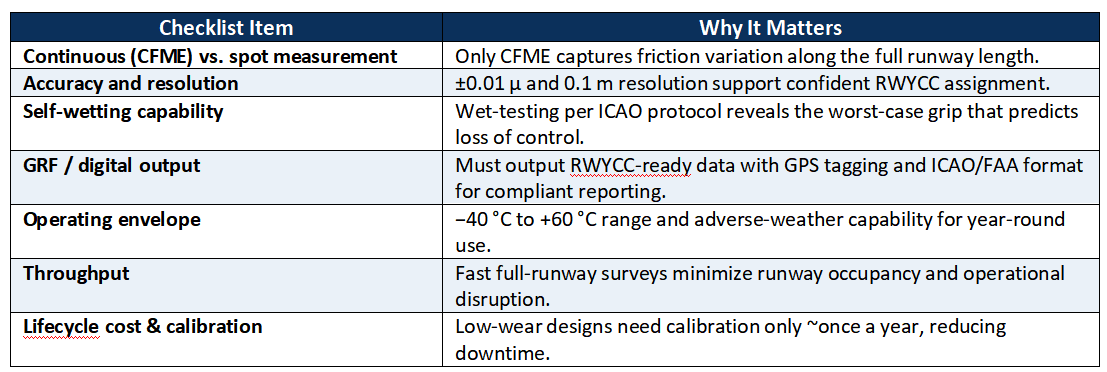
11. Selecting a Runway Friction Tester: Checklist
12. Rubber Contamination and Friction Restoration
Landing gear continuously deposits rubber onto the touchdown zone. Over thousands of landings, this rubber accumulates, fills the pavement's micro-texture, and seals the surface — dramatically reducing friction when the runway is wet. Rubber contamination is invisible in dry conditions but becomes critical in rain, which is why regulators require wet-friction testing rather than dry-only measurement.
Restoration methods include high-pressure water-jetting, chemical solvents, and shot-blasting, all aimed at removing the rubber layer without damaging the pavement's macro-texture. After treatment, friction must be re-measured to confirm the surface has returned to its design objective. Modern programs integrate the friction tester with rubber-removal scheduling: a declining wet-friction trend triggers maintenance before safety is compromised, rather than after an incident.
13. Summer vs. Winter Friction Management
Friction management is not a winter-only activity — it is a year-round discipline with two distinct modes. In summer, the focus is on detecting long-term degradation of pavement micro-texture and rubber accumulation through periodic wet-friction surveys; the goal is to identify surfaces that are losing grip so they can be resurfaced or cleaned before the winter season begins.
In winter, the focus shifts to operational safety: measuring friction after snow and ice events, assigning Runway Condition Codes (RWYCC), and reporting via SNOWTAM so pilots can plan accordingly. Winter measurements must be timely and frequent, because runway condition can change within minutes. A well-managed program therefore treats the friction tester as continuous-use equipment, not a seasonal tool.
14. The History and Evolution of Runway Friction Measurement
Runway friction measurement has evolved dramatically over six decades. Early methods relied on decelerometers — instruments that measured the deceleration of a vehicle during braking — which were simple but inconsistent. The breakthrough came with the continuous-measurement principle: a dedicated measuring wheel at a controlled slip, with force transducers recording load and traction in real time. This 'Skiddometer principle,' developed in the 1960s, remains the industry standard today.
Subsequent decades added self-wetting systems, GPS tagging, digital data logging, and — most recently — software that connects the friction tester directly to GRF-compliant runway reporting. The trend is unmistakable: from coarse spot checks to high-resolution, location-tagged, continuously measured friction profiles that feed real-time safety decisions.
15. Friction Data and the GRF Software Workflow
A modern friction-management program closes the loop between measurement and reporting through software. The friction tester records μ, speed, position, and pavement temperature; the software then converts this into a runway condition assessment, assigns RWYCCs for each runway third, and publishes a SNOWTAM — all without manual transcription errors.
This digital workflow is what the GRF mandate effectively requires: older analog devices cannot produce the structured, standardized output that modern reporting demands. Airports adopting this workflow gain faster, more consistent reporting, an auditable record of every measurement, and the ability to analyze friction trends across seasons to inform resurfacing and maintenance budgets.
16. Friction Tester vs. Decelerometer: When Each Is Appropriate
A full CFME friction tester is not the only way to estimate runway braking action. Portable decelerometers — instruments mounted in a vehicle that measure deceleration during braking — offer a low-cost, rapid indication of braking action. However, decelerometers are less repeatable than a dedicated CFME measuring wheel, cannot produce a continuous length-resolved profile, and are generally not accepted for the formal runway condition assessment required by GRF-compliant reporting.
The practical guidance is clear: use a CFME friction tester for certified, GRF-compliant surveys and regulatory friction monitoring, and reserve decelerometers for a quick operational cross-check when full testing is impractical. For any airport operating jet traffic in a winter climate, a CFME friction tester is the minimum baseline for compliant runway safety management.
17. Frequently Asked Questions (FAQ)
What is a runway friction tester?
It is a specialized vehicle or trailer that measures the coefficient of friction (μ) between a tire and the runway surface by recording the ratio of horizontal tractive force to vertical load on a measuring wheel, producing a friction profile used to assess runway condition.
What is the difference between CFME and spot friction measurement?
Continuous Friction Measuring Equipment (CFME) measures friction along the entire runway length at speed, producing a location-resolved profile, whereas spot methods sample only discrete points and can miss localized low-friction zones.
What friction level is considered safe for landing?
ICAO guidance uses three thresholds: a design objective of μ ≥ 0.74 (new surface, 65 km/h wet), a maintenance planning level of μ = 0.53–0.60, and a minimum level of μ = 0.43–0.50 below which restrictions or closure may be required.
What is the ICAO Global Reporting Format (GRF)?
Mandatory since November 2021, the GRF standardizes runway condition reporting using a Runway Condition Assessment Matrix (RCAM) expressed as a Runway Condition Code (RWYCC) from 0 (very poor) to 6 (dry), published to pilots via SNOWTAM and ATIS.
How often should runway friction be tested?
At least annually for runways serving jet aircraft (ICAO Doc 9137), with additional winter-season and event-driven surveys. In practice, 72% of hub airports now test quarterly or monthly.
Why is a self-wetting system important?
Wet pavement is the worst-case condition that predicts loss of control. A self-wetting system sprays a precisely metered water film (0.5–1.0 mm) so friction is measured under standardized wet conditions, as required by ICAO wet-testing protocols.
How does hydroplaning relate to runway friction?
Hydroplaning occurs when water or another contaminant separates the tire from the runway, eliminating braking. Higher friction — maintained through clean pavement macro-texture and proper condition — resists hydroplaning, which is why wet-friction testing is the standard for assessing the worst-case grip a runway can provide.
What is the difference between a Runway Condition Code and a friction coefficient?
A friction coefficient (μ) is a physical measurement of grip, whereas a Runway Condition Code (RWYCC, 0–6) is a standardized reporting category under the ICAO Global Reporting Format. Friction testers provide the objective μ data that helps an inspector assign the correct RWYCC for publication via SNOWTAM.
Do friction testers work in summer as well as winter?
Yes. In summer, friction testers are used for wet-friction surveys that detect rubber accumulation and pavement texture degradation before winter. In winter, they measure friction after snow and ice events to assign Runway Condition Codes and support safe operations. Modern systems are built for year-round use across −40 °C to +60 °C.
How long does a runway friction survey take?
A modern vehicle-integrated CFME can complete a full 4,000-meter runway survey in under 45 minutes, including wetting, which minimizes runway occupancy and operational disruption. Trailer and portable systems take somewhat longer depending on setup and speed.
Key Takeaways
· A runway friction tester (CFME) measures the friction coefficient μ along the full runway length to quantify braking action.
· ICAO thresholds: design objective μ ≥ 0.74, maintenance planning μ = 0.53–0.60, and minimum μ = 0.43–0.50.
· The Global Reporting Format (GRF), mandatory since Nov 2021, reports runway condition as RWYCC 0–6 via SNOWTAM.
· Friction testers are essential in both summer (rubber and texture monitoring) and winter (contaminated-surface safety).
· The CFME market is growing ~7.2% CAGR as GRF compliance compresses equipment replacement cycles.
18. Conclusion
Runway friction is one of the few variables in aviation that cannot be managed by procedure alone — it must be measured, in standardized conditions, and reported in a format that pilots everywhere interpret the same way. The runway friction tester, and specifically modern continuous friction measuring equipment, is the tool that makes this possible.
With the Global Reporting Format now mandatory worldwide, the friction tester is no longer optional winter equipment — it is core safety infrastructure. Airports that invest in accurate, GRF-compliant CFME, and that manage friction as a continuous, data-driven program rather than a seasonal check, gain a measurable safety advantage and a clear path to regulatory compliance.
Haisen Global supplies continuous and portable runway friction testers, runway-condition software, and GRF-compliance support for airports worldwide. For a technical datasheet, product demonstration, or quotation, contact our team.