How to Detect Unauthorized Drones Near Airports: A Technical Guide for Aviation Safety Professionals
The proliferation of consumer and commercial unmanned aerial systems (UAS), commonly known as drones, presents a growing and complex threat to airport operations worldwide. Incursions by unauthorized drones into controlled airspace have led to flight delays, runway closures, and, in extreme cases, near-miss incidents with manned aircraft. For airport procurement managers and aviation authorities tasked with maintaining runway safety and ensuring continuous operations, the question is no longer *if* a drone incursion will occur, but *when*—and how prepared the airport is to detect and respond.
Understanding how to detect unauthorized drones near airports is not merely a matter of purchasing a single piece of technology. It requires a layered, multi-sensor approach that integrates seamlessly with existing airport ground support equipment and air traffic management systems. This article provides a comprehensive, technically detailed examination of the primary detection methodologies, their operational strengths and limitations, and the compliance frameworks that guide their deployment. We will focus on practical, actionable insights for decision-makers who need to balance security efficacy with operational efficiency, all while adhering to ICAO compliant standards.
The challenge is multifaceted: drones are small, slow, and often made of non-metallic materials, making them difficult to track with traditional aviation radar. Their flight profiles can be erratic, and they can operate at very low altitudes, below the coverage of conventional surveillance systems. Therefore, a robust drone detection system (often called a Counter-UAS or C-UAS system) must combine multiple detection modalities to provide a complete picture of the airspace. This guide will walk you through the core technologies—Radio Frequency (RF) analysis, radar, acoustic sensors, and optical/thermal cameras—explaining how they work individually and, more importantly, how they work together to create a comprehensive security solution for modern airport operations.
The Core Technologies for Drone Detection
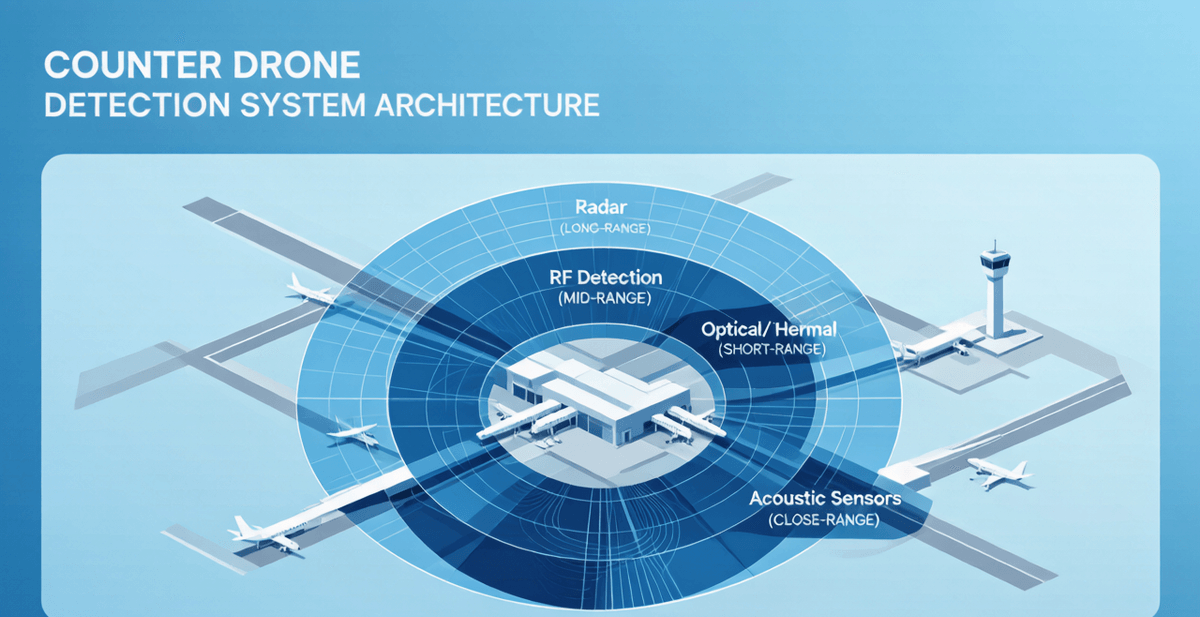
Blog #1 - Technical Diagram
To effectively answer the question of how to detect unauthorized drones near airports, one must first understand the fundamental physics and engineering behind each detection technology. No single technology is a silver bullet; each has distinct advantages and vulnerabilities that must be carefully evaluated against the specific operational environment of an airport.
Radio Frequency (RF) Detection: The Most Common First Line of Defense
RF detection systems work by passively listening for the communication signals between a drone and its controller. Most commercial drones rely on the 2.4 GHz and 5.8 GHz ISM bands for command and control, and many also transmit video feeds on the 5.8 GHz band. An RF sensor can detect, identify, and geolocate these signals.
How it works: A network of RF sensors is deployed around the airport perimeter. These sensors continuously scan the spectrum for known drone communication protocols (e.g., DJI’s Lightbridge, OcuSync, or standard Wi-Fi-based protocols). When a signal is detected, the system can identify the drone model, its unique serial number (if accessible), and the location of both the drone and its pilot using time-difference-of-arrival (TDOA) or angle-of-arrival (AOA) techniques.
Practical advantages for airport operations:
l **Passive and silent:** RF detection emits no energy, making it undetectable to the drone operator and non-interfering with other airport radio systems.
l **Early warning:** It can detect a drone from the moment it is powered on and communicating, often before it is even airborne.
l **Pilot location:** This is a critical forensic and response capability, allowing security personnel to intercept the operator.
Technical limitations and considerations:
l **Dependence on communication:** An autonomous drone flying on a pre-programmed GPS route with no active radio link (e.g., some military or advanced hobbyist models) will be invisible to RF detection.
l **Spectrum congestion:** Airports are noisy RF environments, with numerous radar, communications, and navigation systems. Sophisticated filtering and machine learning algorithms are required to distinguish drone signals from background noise.
l **Limited range:** Effective detection range is typically 1-5 kilometers, depending on the drone’s transmission power and the sensitivity of the RF sensor.
Radar Systems: Tracking the Physical Object
While RF detects the signal, radar detects the physical object itself. However, traditional air traffic control radar is often unsuitable for drone detection. Drones have a very small radar cross-section (RCS), often smaller than a bird. This requires specialized, high-frequency radar systems designed for low-RCS, slow-moving targets.
How it works: Modern C-UAS radars often operate in the X-band (8-12 GHz) or Ku-band (12-18 GHz). These higher frequencies provide better resolution for small objects. They use advanced Doppler processing to filter out stationary clutter (buildings, trees) and track moving objects. Some systems also use micro-Doppler analysis to differentiate between a drone’s rotating propellers and a bird’s flapping wings, significantly reducing false alarms.
Practical advantages for runway safety:
l **Independent of communications:** Radar can detect any drone, regardless of its communication status, including autonomous or jammed drones.
l **Precise 3D tracking:** Provides accurate latitude, longitude, and altitude data, which is essential for air traffic controllers to assess the threat to incoming and departing aircraft.
l **All-weather capability:** Unlike optical systems, radar is generally unaffected by fog, rain, or low-light conditions.
Technical limitations for airport operations:
l **Cost and complexity:** High-performance C-UAS radar is significantly more expensive than RF sensors.
l **Clutter and false alarms:** Airports are cluttered environments with moving ground vehicles, birds, and even wind turbines. Advanced algorithms are required to minimize false alerts, which can distract air traffic controllers.
l **Line-of-sight:** Radar requires a clear line of sight to the target. It cannot detect drones flying behind large hangars or terrain features.
Acoustic Detection: Listening for the Signature
Acoustic sensors use an array of microphones to detect the unique sound signature of a drone’s motors and propellers. Different drone models produce distinct acoustic profiles, which can be compared against a library of known signatures.
How it works: A network of microphone arrays is deployed to capture sound waves. The system uses beamforming to focus on specific directions and cross-correlation to estimate the drone’s location. Advanced systems can even estimate the drone’s altitude and flight path based on the Doppler shift of the sound.
Practical advantages:
l **Passive and low-cost:** No emissions and relatively inexpensive hardware compared to radar.
l **360-degree coverage:** A single array can cover a wide area.
l **Works in cluttered environments:** Sound can diffract around some obstacles, providing limited detection in non-line-of-sight scenarios.
Technical limitations:
l **Ambient noise:** Airports are extremely loud environments (jet engines, ground support equipment, apron vehicles). Acoustic systems require heavy noise filtering and may be ineffective during high-traffic periods.
l **Limited range:** Effective detection range is typically 200-500 meters, making it a short-range, last-line-of-defense technology.
l **Susceptibility to wind:** High winds can mask or distort the acoustic signature of a drone.
Optical and Thermal Cameras: Visual Confirmation and Classification
Optical and thermal cameras are typically used as a secondary, confirmatory sensor. They do not provide wide-area surveillance on their own but are critical for classifying a detected object and providing visual evidence for decision-makers.
How it works: Once an RF or radar system provides a cue (a bearing and approximate location), a pan-tilt-zoom (PTZ) camera is automatically slewed to that location. High-resolution optical cameras can identify the drone model, while thermal cameras can detect the heat signature of the battery and motors, even in total darkness.
Practical advantages for aviation safety equipment integration:
l **Positive identification:** This is the only technology that can *confirm* a detection is a drone and not a bird, a balloon, or a false alarm.
l **Forensic evidence:** High-quality video and still images are invaluable for post-incident analysis and legal proceedings.
l **Night operations:** Thermal cameras are essential for nighttime drone detection, a common time for malicious activities.
Technical limitations:
l **Narrow field of view:** A PTZ camera can only look in one direction at a time. It relies on cueing from other sensors.
l **Range and weather:** Optical cameras are limited by visibility (fog, haze) and have a practical identification range of 1-2 kilometers for small drones.
l **Cost:** High-quality, long-range thermal cameras are expensive.
Integrating Detection into a Layered Airport Security System
Knowing the capabilities of individual technology is only the first step. The true answer to how to detect unauthorized drones near airports lies in the integration of these sensors into a unified command-and-control platform. This is where the system becomes greater than the sum of its parts.
A layered detection architecture typically follows a tiered approach:
1. **Long-Range Surveillance (Radar):** Provides wide-area search and initial detection of any airborne object.
2. **Mid-Range Identification (RF):** Correlates radar tracks with known drone communication signals, identifying the drone type and pilot location.
3. **Short-Range Confirmation (Optical/Thermal):** Provides visual confirmation and classification of the threat.
4. **Final Verification (Acoustic):** Acts as a redundant sensor for close-range detection, particularly in urban canyons or near terminal buildings.
This multi-sensor fusion dramatically reduces false alarm rates. For example, if a radar detects a small object, the system can automatically check if an RF signal is present. If no RF signal is found, the system may classify it as a bird. If an RF signal is found, the optical camera is cued to provide a visual. This process ensures that air traffic controllers and security personnel are not overwhelmed by alerts from birds, ground vehicles, or other non-threat objects.
For airport operations, this integrated approach must also interface with existing systems. The C-UAS command-and-control platform should be able to share track data with the airport’s surface movement radar and air traffic control displays via standard protocols like ASTERIX. This allows controllers to see drone tracks alongside aircraft tracks, making informed decisions about runway closures or flight diversions. Furthermore, the system must be designed to be ICAO compliant with the growing body of international standards for UAS detection and mitigation in airport environments, such as those outlined in ICAO Doc 9985 (Manual on UAS) and relevant national civil aviation authority regulations.
Compliance, Standards, and the Role of ICAO
Deploying a drone detection system at an airport is not just a technical exercise; it is a regulatory one. Airport procurement managers must ensure that any C-UAS solution they evaluate is designed to operate within the strict electromagnetic and operational environment of an airport without causing interference to critical aviation safety equipment systems.
ICAO Compliant Systems: A Non-Negotiable Requirement
Any detection system intended for permanent or semi-permanent installation at an airport must be ICAO compliant in spirit and, where applicable, in specific technical standards. While ICAO does not prescribe a single standard for C-UAS, it provides a framework for risk assessment and system performance. Key considerations include:
l **Non-Interference:** The detection system must not emit any radio frequency energy that could interfere with aircraft navigation (ILS, VOR, DME), communication (VHF voice), or surveillance (Secondary Surveillance Radar, ADS-B) systems. Passive detection systems like RF and acoustic are inherently low-risk. Active systems like radar must be carefully frequency-coordinated and certified to ensure they do not cause harmful interference.
l **Data Integration:** The system should be capable of sharing detection data with Air Traffic Management (ATM) systems in a standardized format. This is crucial for maintaining **runway safety** and ensuring that controllers have a common operating picture.
l **Operational Approval:** In many jurisdictions, the operation of a C-UAS system (especially one that includes mitigation capabilities like jamming or spoofing) requires specific approval from the national aviation authority (e.g., FAA in the US, EASA in Europe). Detection-only systems generally face fewer regulatory hurdles but must still be proven safe for the airport environment.
The Importance of Testing and Certification
When evaluating suppliers, procurement managers should look for evidence of independent testing and certification. Has the system been tested at a live airport environment? Does it have a proven track record of low false alarm rates in high-clutter environments? Is the manufacturer willing to provide a detailed electromagnetic compatibility (EMC) report? These are critical questions. A system that works flawlessly in a desert test range may fail spectacularly in the RF-busy, clutter-rich environment of a major international airport.
Operational Considerations and Response Protocols
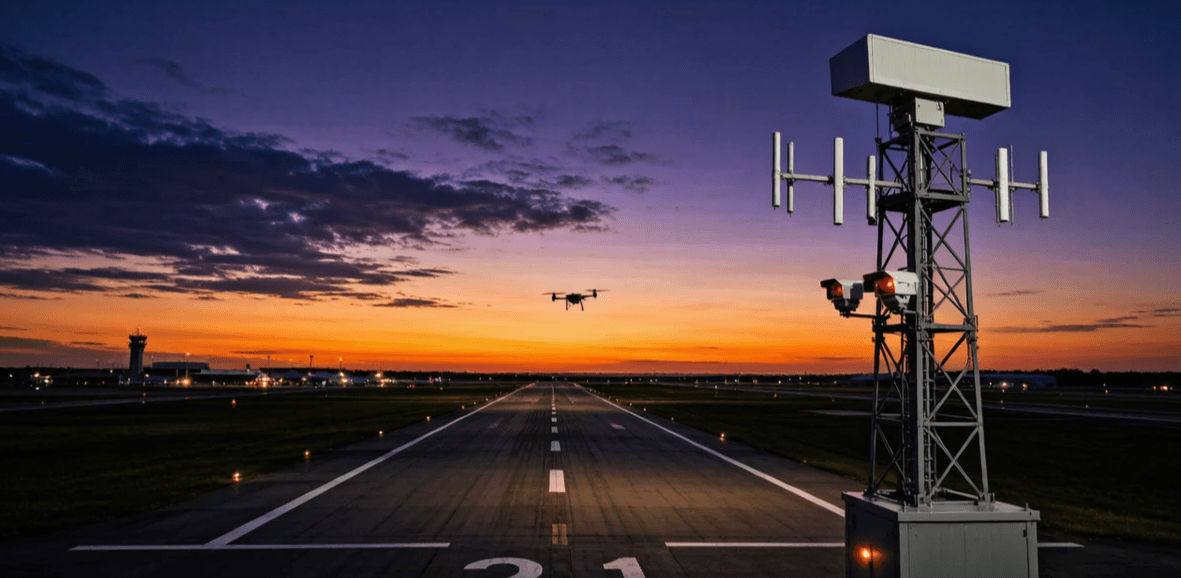
Detection is only half the battle. Once a drone is detected, what happens next? A well-defined response protocol is essential. This is where the detection system must integrate with airport security and air traffic control procedures.
Defining Threat Levels
Not every drone detection requires a full runway closure. A robust system allows for graduated responses based on the drone’s location, altitude, and behavior.
l **Level 1 (Alert):** Drone detected outside the Airport Movement Area (e.g., > 5 km from the runway). Action: Log the event, increase monitoring.
l **Level 2 (Warning):** Drone detected approaching the Airport Movement Area (e.g., within 2-5 km). Action: Alert air traffic control, notify security, prepare response teams.
l **Level 3 (Critical):** Drone detected over the runway, approach path, or taxiway. Action: Immediately halt departures, divert arrivals, activate response teams. This is a direct threat to **runway safety**.
The Challenge of Mitigation
It is important to distinguish between detection and mitigation. This article focuses on detection. However, procurement managers must be aware that many C-UAS systems also offer mitigation capabilities, such as RF jamming, GNSS spoofing, or kinetic interception (e.g., net guns, drones with nets). Mitigation capabilities are heavily regulated and often illegal for civilian airports to deploy without specific government authorization. Jamming, for example, can disrupt critical airport communications and navigation systems. Therefore, many airports initially focus on a robust detection-only system to provide situational awareness, while relying on law enforcement agencies to handle the mitigation and apprehension of the drone operator.
Training and Workflow Integration
The best detection system in the world is useless if the operators are not trained to use it effectively. Airport operations staff, air traffic controllers, and security personnel must undergo joint training on the system’s interface, alert thresholds, and response protocols. The system should be integrated into the daily workflow, not treated as a separate, rarely-checked tool. Regular drills simulating drone incursions are essential to test both the technology and the human response.
The Role of Airport Ground Support Equipment in a C-UAS Strategy
While not directly a detection tool, airport ground support equipment (GSE) plays a subtle but important role in the overall C-UAS strategy. The mere presence of a robust detection system can influence the operational environment.
Reducing False Alarms from GSE
Many false alarms in radar-based C-UAS systems are caused by moving GSE, such as baggage tugs, fuel trucks, and catering vehicles. To mitigate this, the detection system must be integrated with the airport’s vehicle tracking system (e.g., using ADS-B or multilateration on ground vehicles). By knowing the location of all active GSE, the C-UAS system can automatically filter out these legitimate moving objects, drastically reducing false alerts and operator fatigue.
Physical Security and GSE
While not a detection technology, the physical layout and security of GSE storage areas can be a factor. Drones are often launched from nearby locations, including vehicle parks. Ensuring that GSE storage areas are well-lit and monitored by security cameras can deter operators from using these areas as launch points. This is a low-tech but effective complement to a high-tech detection system.
FAQ: How to Detect Unauthorized Drones Near Airports
Q1: What is the single most important technology for detecting drones at an airport?
There is no single "best" technology. A layered approach is essential. Radio Frequency (RF) detection is often the most cost-effective first line of defense for identifying drones and their pilots. However, for comprehensive coverage, especially against autonomous drones, a specialized C-UAS radar is critical. The key is sensor fusion—combining RF, radar, optical, and acoustic data into a single, unified picture.
Q2: How can an airport ensure its drone detection system is ICAO compliant?
Ensure the system is passive (or if active, frequency-coordinated to avoid interference with aviation safety equipment). The system must be capable of sharing track data with Air Traffic Management systems (e.g., via ASTERIX protocol). Finally, work with your national aviation authority during the procurement and deployment process to ensure the system meets all local and international standards for airport safety.
Q3: What is the typical range of a drone detection system for an airport?
Range varies significantly by technology. RF detection typically works from 1-5 km. Specialized C-UAS radar can detect small drones at 3-10 km, depending on the radar’s power and the drone’s size. Acoustic sensors are short-range (200-500m). Optical cameras can identify drones at 1-2 km. A comprehensive system should provide detection out to at least the boundaries of the airport’s controlled airspace.
Q4: Can a drone detection system be integrated with existing airport operations, like air traffic control?
Yes, this is a critical requirement. A modern C-UAS command-and-control platform should be designed to integrate with existing ATC displays and airport security systems. This allows controllers to see drone tracks alongside aircraft tracks, enabling informed decisions about runway safety without requiring a separate, standalone monitor.
Q5: How do we reduce false alarms from birds or ground support equipment?
False alarm reduction is achieved through advanced sensor fusion and machine learning. Radar systems use micro-Doppler analysis to differentiate drone propellers from bird wings. The system should also be integrated with the airport’s vehicle tracking database to automatically filter out moving ground support equipment. A high-fidelity system should achieve a false alarm rate of less than one per day in a busy airport environment.
Conclusion: A Strategic Imperative for Modern Airport Operations
The ability to detect unauthorized drones near airports is no longer a niche security concern; it is a fundamental requirement for maintaining safe and efficient airport operations. The threat is real, persistent, and evolving. For procurement managers and aviation authorities, the path forward is clear: invest in a layered, multi-sensor detection system that is ICAO compliant, integrates seamlessly with existing air traffic control and security infrastructure, and provides a graduated, actionable response capability.
The decision should not be based on a single technology’s marketing claims but on a holistic assessment of the airport’s specific risk profile, physical layout, and operational demands. A system that combines RF, radar, and optical sensors, fused by intelligent software, offers the most robust and reliable protection. Companies like Haisen Technology have demonstrated how integrated sensor fusion can provide a comprehensive, scalable solution that meets the stringent demands of modern airport environments, from major international hubs to regional airports.
Ultimately, the investment in drone detection is an investment in runway safety, passenger confidence, and operational continuity. By taking a proactive, technically informed approach, airports can transform a growing vulnerability into a managed risk, ensuring that the skies remain safe for all users. The time to act is now. Start by conducting a thorough threat assessment, engage with qualified C-UAS vendors, and develop a phased deployment plan that prioritizes detection first, with a clear path toward mitigation within the regulatory framework of your aviation authority. This is not just about buying equipment; it is about building a culture of security that protects your airport, your passengers, and your bottom line.