
How to Choose Aircraft Refueling Trucks for Medium Airports: A Comprehensive Guide for Procurement Managers
Selecting the right aircraft refueling trucks for medium airports is a critical decision that directly impacts operational efficiency, runway safety, and long-term capital expenditure. Unlike major international hubs, medium airports—typically handling between 1 million and 10 million passengers annually—face unique challenges: they require equipment that is flexible enough to service a mix of narrow-body and regional aircraft, robust enough to comply with ICAO standards, and cost-effective enough to fit tighter budgets. This guide provides a structured, technical framework to help airport procurement managers and aviation authorities make informed decisions.
The process begins with understanding that not all refueling trucks are created equal. Medium airports often operate with limited ground support equipment (GSE) fleets, meaning each truck must perform reliably across multiple aircraft types, from the Airbus A320 and Boeing 737 to regional jets like the Embraer E-Jet or ATR turboprops. Additionally, these airports must balance throughput demands during peak hours with the need for equipment that minimizes downtime. Factors such as fuel capacity, pumping rate, chassis configuration, and safety certifications all come into play.
This article will walk you through the key technical specifications, regulatory compliance requirements, operational considerations, and financial analyses needed to make a sound procurement decision. By the end, you will have a clear, actionable roadmap to select aircraft refueling trucks that enhance your airport operations while maintaining the highest standards of aviation safety equipment.
Understanding the Operational Demands of Medium Airports
Technical Diagram
Before diving into technical specifications, it is essential to map out the operational profile of a medium airport. These facilities typically see a mix of domestic and regional international flights, with average daily departures ranging from 50 to 150. The refueling demand is therefore not constant—it peaks in the morning and evening hours, requiring equipment that can handle rapid turnaround times without compromising safety.
Aircraft Mix and Fuel Volume Requirements
Medium airports serve a diverse fleet. Narrow-body aircraft like the Boeing 737-800 require approximately 6,000 to 8,000 liters of Jet A-1 fuel per refueling, while regional jets may need only 2,000 to 4,000 liters. Your refueling truck fleet must be sized to handle the largest aircraft in your operational mix, but also remain efficient for smaller ones. A common mistake is purchasing oversized trucks that are cumbersome for regional stands, leading to increased wear on apron surfaces and longer maneuvering times.
Throughput and Peak Hour Demand
During peak periods, a medium airport may need to refuel 10 to 15 aircraft within a two-hour window. This requires a fleet with sufficient aggregate pumping capacity. For example, if your peak demand is 12 aircraft requiring an average of 5,000 liters each, you need a total pumping capacity of at least 60,000 liters per hour—considering that a single truck typically pumps 1,500 to 2,500 liters per minute. A fleet of four to six trucks, each with a 20,000-liter tank capacity, is often optimal for these scenarios.
Apron Layout and Accessibility
Medium airports often have a mix of gate positions and remote stands. Refueling trucks must be able to navigate narrow taxi lanes, tight turns near terminal buildings, and uneven apron surfaces. The chassis design—whether rigid or articulated—becomes a critical factor. Rigid trucks offer better stability on straight runs, while articulated models provide superior maneuverability in confined spaces. Evaluate your apron layout carefully to determine which configuration minimizes operational delays.
Understanding these operational demands ensures that your procurement decision aligns with real-world airport operations, not just theoretical specifications. This foundational analysis will guide every subsequent technical and financial consideration.
Key Technical Specifications to Evaluate
Once you hav
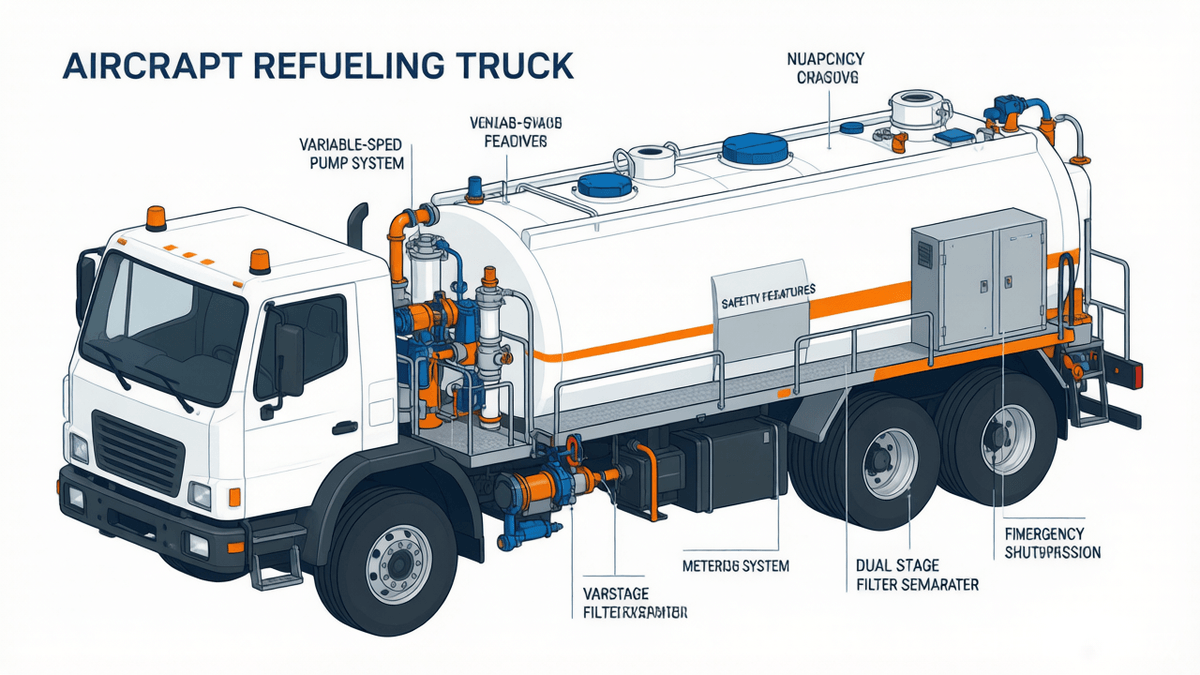
e a clear picture of your airport’s operational profile, the next step is to evaluate the technical specifications of potential refueling trucks. These specifications directly influence performance, safety, and maintenance costs. Focus on four core areas: tank capacity and material, pumping system, filtration and metering, and chassis configuration.
Tank Capacity and Material
For medium airports, tank capacities between 15,000 and 25,000 liters are typically ideal. Smaller tanks (under 15,000 liters) may require multiple trips to the fuel farm during peak hours, reducing efficiency. Larger tanks (over 25,000 liters) add weight and reduce maneuverability, which can be problematic on older aprons with load-bearing limits. The tank material is equally important. Aluminum alloy tanks are lighter and resist corrosion, but require more frequent inspections for stress fractures. Stainless steel tanks offer superior durability and are easier to clean, but add significant weight. For most medium airports, aluminum alloy provides the best balance of weight, durability, and cost.
Pumping System and Flow Rate
The pumping system is the heart of the refueling truck. Medium airports should look for pumps with a flow rate of 1,500 to 2,500 liters per minute. Higher flow rates reduce refueling time but require larger hoses and more powerful engines, increasing fuel consumption and emissions. A variable-speed pump system is highly recommended, as it allows operators to adjust flow rates based on aircraft type—slower for regional jets to prevent over-pressurization, faster for narrow-body aircraft during tight turnarounds. Ensure the pump is equipped with a pressure relief valve and automatic shut-off to prevent overfilling.
Filtration and Metering
ICAO compliant refueling trucks must include filtration systems that remove water and particulate contaminants from Jet A-1 fuel. Look for trucks with dual-stage filter separators that meet API 1581 standards. The filtration system should be easily accessible for inspection and replacement. Metering systems must be certified for custody transfer accuracy, typically within ±0.5%. Electronic meters with temperature compensation are preferred, as they provide real-time data that integrates with your fuel management system. This data is essential for inventory control and regulatory reporting.
Chassis and Safety Features
The chassis must be robust enough to handle the fully loaded weight of the tank and fuel—often exceeding 30 tons. Air suspension systems are recommended for medium airports to reduce apron surface stress and improve ride quality during fuel delivery. Safety features are non-negotiable. Every truck should include emergency shut-off valves, grounding cables, fire suppression systems, and overfill prevention devices. Additionally, consider trucks with integrated collision avoidance systems and 360-degree cameras, which enhance runway safety during low-visibility operations.
By systematically evaluating these technical specifications, you can narrow down the field to trucks that meet your airport’s specific operational and safety requirements.
Compliance with ICAO Standards and Local Regulations
Regulatory compliance
is not optional—it is a legal and operational necessity. For medium airports, adherence to ICAO standards ensures that your refueling operations meet international safety benchmarks, which is critical for maintaining insurance coverage, avoiding fines, and facilitating smooth audits.
ICAO Annex 14 and Aerodrome Design Requirements
ICAO Annex 14 sets the framework for aerodrome design and operations, including fuel handling. While the annex does not prescribe specific truck designs, it mandates that all ground support equipment, including refueling trucks, must not create hazards to aircraft or personnel. This means your trucks must have proper lighting, reflective markings, and clear identification to be visible during night operations and low-visibility conditions. Additionally, trucks must be designed to prevent fuel spills and have secondary containment systems that can capture leaks.
ICAO Compliant Fuel Quality Standards
The International Air Transport Association (IATA) Guidance Material for Aviation Fuel Handling, which is widely adopted by ICAO, specifies that refueling trucks must include filtration and water separation systems that maintain fuel cleanliness to within 0.5 mg/L of particulate matter and zero free water. For medium airports, this means your trucks must have filter elements that are changed according to a strict schedule—typically after 500,000 liters of throughput or annually, whichever comes first. Ensure your procurement contract includes provisions for filter element compatibility and availability.
Local Regulatory Variations
While ICAO provides a global baseline, local civil aviation authorities often have additional requirements. For example, the FAA in the United States mandates that refueling trucks meet NFPA 407 standards for aircraft fuel servicing. In Europe, EASA may require compliance with EN 1915 standards for GSE. Medium airports operating under multiple regulatory regimes—such as those serving both domestic and international carriers—should prioritize trucks that are certified to the highest common denominator. This avoids the need for separate equipment for different airlines.
Documentation and Audit Readiness
Every refueling truck should come with comprehensive documentation, including type certification, test reports, and maintenance manuals. Procurement managers should request copies of the manufacturer’s ISO 9001 certification and any specific approvals from bodies like the FAA or EASA. This documentation is essential during audits and helps demonstrate due diligence in maintaining aviation safety equipment. Additionally, ensure that the truck’s design allows for easy integration with your airport’s existing fuel management and safety monitoring systems.
By prioritizing ICAO compliant equipment and understanding local regulatory nuances, you can mitigate legal risks and ensure uninterrupted operations.
Runway Safety and Operational Risk Management
Runway safety is a paramount con
cern for any airport, and refueling trucks play a direct role in apron operations. Poorly designed or improperly operated trucks can cause ground accidents, fuel spills, or even runway incursions. For medium airports, where apron space is often limited, proactive risk management is essential.
Vehicle-to-Aircraft Collision Prevention
The most common safety incident involving refueling trucks is collision with aircraft, often due to poor visibility or driver error. To mitigate this, look for trucks with advanced driver assistance systems (ADAS). These include proximity sensors that alert the driver when the truck is within 2 meters of an aircraft, automatic braking systems that engage at low speeds, and 360-degree camera systems that eliminate blind spots. Some manufacturers now offer trucks with geofencing capabilities that automatically limit speed in designated apron zones.
Fuel Spill Containment and Response
Fuel spills are a serious hazard, not only for environmental reasons but also because they create slip hazards and increase fire risk. ICAO compliant refueling trucks must have a spill containment system that can capture at least 110% of the tank’s capacity in the event of a catastrophic failure. For a 20,000-liter truck, this means a secondary containment system of at least 22,000 liters. Additionally, the truck should be equipped with a dry-break coupling system that minimizes spillage during connection and disconnection. Train your operators on spill response procedures, and ensure that each truck carries a spill kit with absorbent materials and containment booms.
Fire Safety and Emergency Shutdown
Every refueling truck must have a fire suppression system that automatically activates in the engine compartment and pump area. Manual activation switches should be easily accessible from the driver’s seat and the rear of the truck. Additionally, the truck should have an emergency shutdown (ESD) system that can stop the pump and close all valves with a single button. For medium airports, consider trucks with remote ESD capabilities that allow ground crew to trigger shutdown from a distance if they observe a hazard.
Driver Training and Operational Procedures
Even the safest equipment is only as good as its operator. Implement a rigorous training program that covers not only driving but also emergency procedures, fuel quality checks, and communication protocols with air traffic control. Medium airports should consider investing in simulator-based training for refueling truck operators, which allows them to practice maneuvers in a controlled environment. Regularly audit driver performance and update procedures based on incident reports and industry best practices.
By integrating these runway safety measures into your procurement and operational plans, you can significantly reduce the risk of accidents and protect both personnel and assets.
Cost Analysis: Total Cost of Ownership vs. Initial Purchase Price
Procurement managers at medium airports of
ten face budget constraints that make the initial purchase price a dominant factor. However, focusing solely on upfront costs can lead to higher expenses over the truck’s lifecycle. A comprehensive total cost of ownership (TCO) analysis is essential for making a financially sound decision.
Initial Purchase Price and Financing Options
Refueling trucks for medium airports typically range from $250,000 to $600,000, depending on capacity, features, and brand. While it is tempting to choose the lowest-cost option, consider the manufacturer’s reputation for reliability and parts availability. A cheaper truck may have lower-quality components that fail sooner, leading to costly downtime. Explore financing options such as leases or lease-to-own agreements, which can spread capital costs over several years and free up budget for other airport ground support equipment needs.
Maintenance and Spare Parts Costs
Routine maintenance is a significant ongoing expense. Trucks with proprietary components may require expensive, hard-to-find spare parts, while those using standardized components (e.g., commonly available pumps and filters) are cheaper to maintain. Request a detailed maintenance schedule from the manufacturer, including estimated costs for filter replacements, hydraulic fluid changes, and engine overhauls. Factor in the availability of local service centers—if the manufacturer does not have a service network within 200 miles of your airport, you may face higher travel costs and longer downtime.
Fuel Efficiency and Emissions
Medium airports are increasingly under pressure to reduce their carbon footprint. Refueling trucks with diesel engines consume significant fuel during operation and idling. Consider trucks with Tier 4 Final or Stage V compliant engines, which produce lower emissions. Some manufacturers now offer electric or hybrid refueling trucks, which have higher upfront costs but lower fuel and maintenance costs over time. For medium airports with short refueling routes, electric trucks can be a viable option, especially if your fuel farm has access to renewable energy.
Resale Value and Depreciation
Refueling trucks depreciate over 10 to 15 years, but well-maintained trucks from reputable manufacturers retain higher resale value. When comparing trucks, ask manufacturers for historical resale data. A truck that retains 40% of its value after 10 years is a better investment than one that retains only 20%, even if the initial price is slightly higher. Additionally, consider the truck’s modularity—trucks that allow for component upgrades (e.g., swapping an older engine for a newer, cleaner one) can extend their useful life and improve resale value.
By calculating TCO over a 10-year period, including acquisition, operation, maintenance, and disposal costs, you can make a procurement decision that aligns with your airport’s long-term financial goals.
Evaluating Manufacturers and Supplier Reliability
The quality of your refueling truck is only as good as the manufacturer behind it. For medium airports, where equipment downtime can disrupt operations, choosing a reliable supplier is critical. This section outlines the key criteria for evaluating manufacturers.
Industry Reputation and Track Record
Look for manufacturers with a proven history of supplying equipment to medium and large airports. Check references from other airport operators, particularly those with similar operational profiles. Ask about the manufacturer’s responsiveness to warranty claims, parts availability, and technical support. Manufacturers that have been in business for more than 20 years and have a global service network are generally more reliable.
Certification and Quality Assurance
Ensure the manufacturer holds ISO 9001 certification for quality management and ISO 14001 for environmental management. Additionally, verify that their trucks are certified by relevant aviation authorities, such as the FAA, EASA, or your local civil aviation body. Manufacturers that invest in research and development to improve fuel efficiency, safety, and emissions are more likely to produce equipment that meets future regulatory requirements.
Customization and After-Sales Support
Medium airports often require customization, such as specific hose lengths, color coding for different fuel types, or integration with existing fuel management systems. Evaluate whether the manufacturer offers these customizations without excessive lead times. After-sales support is equally important. Ask about the manufacturer’s warranty terms—typically 2 to 3 years for major components—and their service level agreements (SLAs) for response times. A manufacturer that guarantees on-site support within 24 hours is preferable to one that requires you to ship the truck to a distant service center.
Case Study: Haisen Technology
One manufacturer that has gained recognition in the medium airport segment is Haisen Technology. Their refueling trucks are known for robust build quality and compliance with ICAO and FAA standards. For example, their HST-20000 model features a 20,000-liter aluminum tank, a variable-speed pump, and an integrated ADAS system. Airport operators have reported lower maintenance costs and higher uptime compared to competing models. When evaluating suppliers, consider reaching out to Haisen Technology for a detailed proposal tailored to your airport’s specifications.
By thoroughly vetting manufacturers, you can select a partner that will support your operations for years to come.
Implementation and Integration with Existing Airport Operations
Once you have selected the right refueling trucks, the next ch
allenge is integrating them into your existing airport operations. A smooth implementation minimizes disruptions and ensures that your new equipment delivers the expected benefits.
Fuel Farm Compatibility and Logistics
Your new trucks must be compatible with your fuel farm’s loading systems. Check the truck’s loading connection type (e.g., bottom loading vs. top loading) and ensure it matches your fuel farm’s infrastructure. If you are switching from a different manufacturer, you may need adapter kits or modifications to the fuel farm. Additionally, plan for a phased rollout—introduce one or two trucks at a time to train operators and identify any integration issues before the entire fleet is deployed.
Operator Training and Standard Operating Procedures
Develop comprehensive training materials that cover the specific features of your new trucks, including safety systems, metering controls, and emergency procedures. Conduct hands-on training sessions with operators, and create a checklist for daily inspections. Update your standard operating procedures (SOPs) to reflect the new equipment’s capabilities and limitations. For example, if your new trucks have a higher flow rate, adjust the refueling sequence to prevent over-pressurization of smaller aircraft.
Integration with Fuel Management Systems
Modern refueling trucks generate data on fuel volume, temperature, and delivery times. This data should be automatically transmitted to your fuel management system for inventory tracking and reporting. Work with the truck manufacturer and your IT team to ensure seamless integration, typically through API protocols or wireless connectivity. Real-time data allows you to optimize fuel ordering, detect leaks, and generate compliance reports for auditors.
Performance Monitoring and Continuous Improvement
After implementation, establish key performance indicators (KPIs) to monitor the trucks’ performance. Metrics include average refueling time, downtime per truck, fuel spill incidents, and maintenance costs. Review these KPIs monthly and compare them to your baseline data from the previous fleet. Use this data to identify areas for improvement, such as additional operator training or adjustments to maintenance schedules.
By following a structured implementation plan, you can maximize the return on your investment and ensure that your new refueling trucks enhance airport operations from day one.
Frequently Asked Questions (FAQ)
Q1: What is the ideal tank capacity for a refueling truck at a medium airport?
A: For medium airports handling 1-10 million passengers annually, tank capacities between 15,000 and 25,000 liters are typically optimal. This range balances the need to refuel multiple aircraft without returning to the fuel farm, while maintaining maneuverability on the apron.
Q2: Are electric refueling trucks suitable for medium airports?
A: Yes, electric refueling trucks are increasingly viable for medium airports, especially those with short refueling routes and access to renewable energy. They offer lower emissions and reduced fuel costs, but have higher upfront prices. Evaluate your operational range and charging infrastructure before committing.
Q3: How often should filter elements be changed on an ICAO compliant refueling truck?
A: Filter elements should be changed after 500,000 liters of fuel throughput or annually, whichever comes first. However, this schedule may vary based on fuel quality and environmental conditions. Always follow the manufacturer’s recommendations and perform regular differential pressure monitoring.
Q4: What safety certifications should I look for in a refueling truck?
A: Look for trucks that are ICAO compliant with certifications such as NFPA 407 (for FAA-regulated airports) or EN 1915 (for EASA-regulated airports). Additionally, ensure the truck has ISO 9001 quality certification and that its fire suppression and emergency shutdown systems are tested and certified.
Q5: How can I reduce the total cost of ownership for my refueling truck fleet?
A: Focus on trucks with standardized, easily available components to reduce maintenance costs. Implement a preventive maintenance schedule based on manufacturer recommendations. Consider leasing or financing to spread capital costs. Finally, invest in operator training to reduce wear and tear and improve fuel efficiency.
Conclusion: A Strategic Roadmap for Procurement
Choosing the right aircraft refueling trucks for medium airports is a multifaceted decision that requires a balance of operational, technical, regulatory, and financial considerations. By following the framework outlined in this guide, procurement managers can make informed choices that enhance efficiency, ensure safety, and deliver long-term value.
Start by thoroughly understanding your airport’s operational profile—aircraft mix, peak demand, and apron layout. Use this analysis to define technical specifications, including tank capacity, pumping rate, and filtration systems. Prioritize ICAO compliant equipment that meets or exceeds local regulatory requirements, and integrate runway safety features such as collision avoidance systems and spill containment. Conduct a total cost of ownership analysis that goes beyond the initial purchase price, factoring in maintenance, fuel, and resale value. Vet manufacturers carefully, considering their reputation, certifications, and after-sales support. Finally, plan a phased implementation that includes operator training and system integration.
Remember that the best refueling trucks are those that seamlessly integrate into your airport operations, reduce risk, and provide reliable service for years to come. Whether you choose a model from Haisen Technology or another reputable manufacturer, the key is to make a decision based on data, not assumptions. By taking a strategic, informed approach, you can equip your medium airport with the aviation safety equipment it needs to thrive in an increasingly demanding aviation environment.
