Anti-drone jamming technology is a counter-UAV method that disrupts the radio frequency (RF) communication links between an unmanned aerial vehicle (UAV) and its operator, forcing the drone to enter a failsafe mode such as landing, hovering, or returning to its launch point. When integrated with radar detection and electro-optical tracking systems, RF jamming forms the core of a comprehensive anti-drone defense system capable of protecting airports, critical infrastructure, and restricted airspace from unauthorized drone incursions.
The threat of unauthorized drones near airports has escalated dramatically. According to ICAO and FAA incident reports, drone sightings near airports increased by over 300% between 2020 and 2025, causing hundreds of flight cancellations, runway closures, and passenger delays. For airports in emerging markets across Africa, the Middle East, Central Asia, and Latin America, where regulatory frameworks for civilian drone operations may still be developing, deploying effective counter-drone technology is increasingly urgent.
What Is Anti-Drone Jamming Technology?
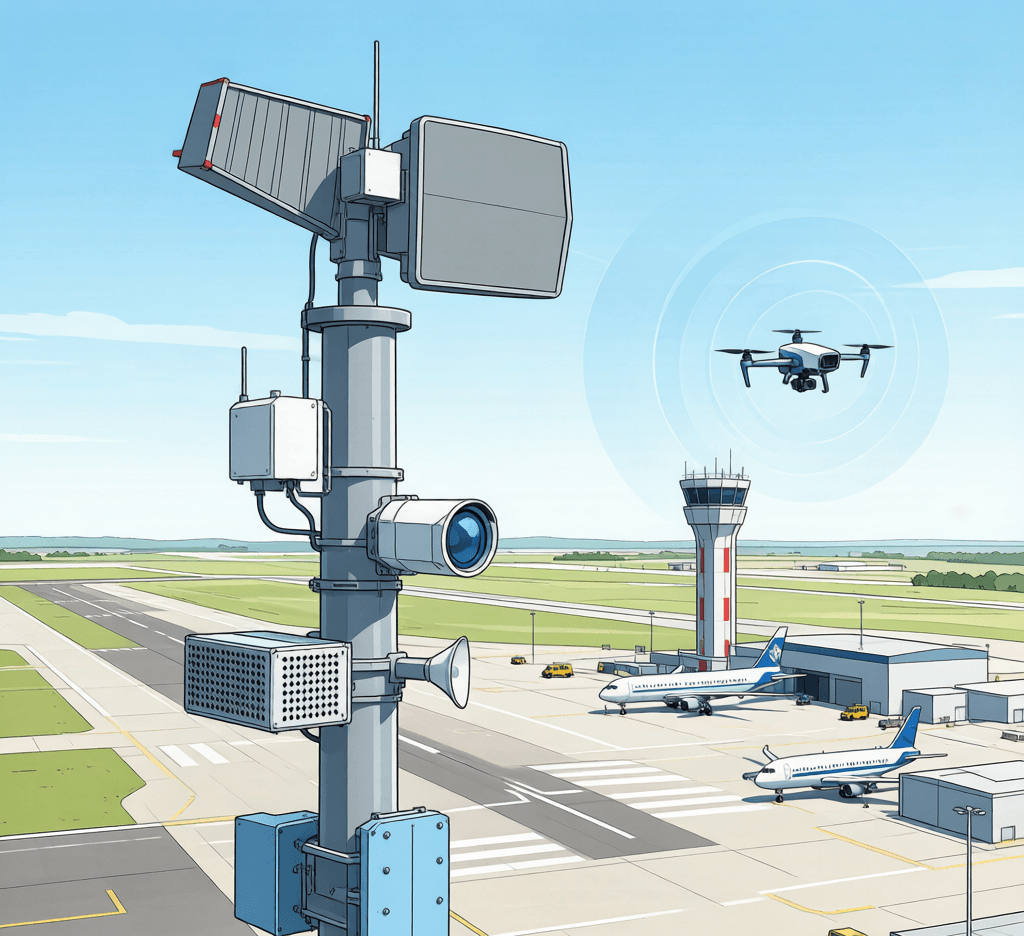
Image: Anti-drone jamming system with RF antenna array deployed at an airport perimeter for counter-UAV defense
Anti-drone jamming technology is a subset of counter-UAV (C-UAV) systems that uses directed radio frequency energy to overwhelm or deny the communication signals that a drone relies on for command, control, navigation, and video transmission. Unlike kinetic countermeasures (nets, projectiles) that physically capture or destroy a drone, RF jamming is a non-destructive method that neutralizes the threat without causing debris that could endanger aircraft or people on the ground.
The Haisen Anti-Drone Defense System is a comprehensive counter-UAV solution that integrates low-altitude detection radar, electro-optical recognition and tracking, spectrum detection equipment, and RF jamming modules to provide multi-layered protection against drone threats. The system is available in both fixed and portable configurations.
How RF Jamming Works Against Drones
Command and Control Link Disruption
Most consumer and commercial drones communicate with their operators using radio frequencies in the 2.4 GHz and 5.8 GHz ISM bands. Some military-grade drones also use frequencies in the 400–900 MHz range. RF jamming works by transmitting a high-power signal on these same frequencies, creating a signal-to-noise ratio that makes it impossible for the drone to receive commands from its operator.
When the command link is disrupted, the drone's onboard flight controller enters a pre-programmed failsafe mode. Depending on the drone model and configuration, this typically results in one of the following behaviors:
· Return to home (RTH): The drone attempts to fly back to its launch coordinates using onboard GPS
· Hover in place: The drone maintains its current position until battery depletion
· Controlled landing: The drone descends vertically and lands at its current location
In all cases, the drone is neutralized as a threat to airport operations without requiring physical interception.
GPS Signal Denial
In addition to command link disruption, advanced anti-drone jamming systems can also deny GPS/GNSS signals. GPS jamming prevents the drone from determining its position, which is particularly effective against autonomous drones that rely on GPS waypoints for navigation.
GPS jamming operates on the L1 (1575.42 MHz), L2 (1227.60 MHz), and L5 (1176.45 MHz) GPS frequency bands. When GPS is denied, drones that lack inertial navigation systems (INS) as a backup will typically enter hover mode or execute an emergency landing.
Frequency Bands and Coverage
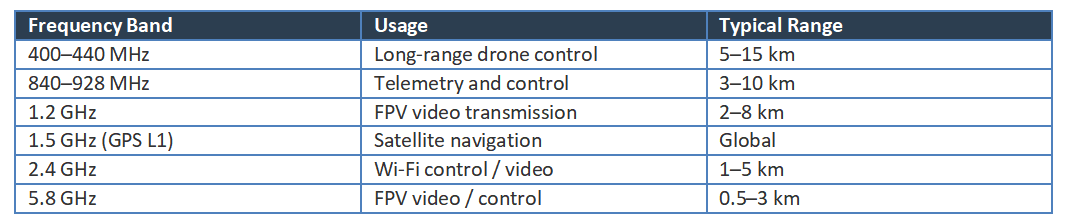
Haisen's full-band jamming systems cover all of these frequencies simultaneously, ensuring protection against the full spectrum of civilian and commercial drone threats.
Detection-Jamming Integration: The Three-Layer Approach
Effective counter-drone defense requires more than just jamming — it requires the ability to detect, identify, track, and then neutralize the threat. Haisen's system follows a three-layer architecture:
Layer 1: Radar Detection
Low-altitude surveillance radar provides 360° coverage of the airport perimeter, detecting small drones at ranges of 5–10 km. The radar identifies potential targets by their radar cross-section (RCS), velocity, and altitude profile, filtering out birds, ground vehicles, and other non-threat objects.
Key radar specifications:
· Detection range: 5–10 km for typical consumer drones (RCS 0.01 m²)
· Altitude coverage: 10–1,000 meters
· Scan rate: 2–4 seconds for full 360° sweep
· Multi-target tracking: Up to 50 simultaneous targets
Layer 2: Electro-Optical and Spectrum Confirmation
Once radar detects a potential target, the system automatically directs an electro-optical (EO) camera and spectrum analyzer to confirm the target is a drone (not a bird or debris). The EO camera provides visual identification and tracking, while the spectrum analyzer confirms the presence of drone communication signals.
This confirmation step is critical to reduce false alarm rates. Radar alone cannot reliably distinguish between a drone and a large bird; the EO/spectrum layer provides the positive identification needed before engaging jamming.
Layer 3: RF Jamming Engagement
Once the target is confirmed as an unauthorized drone, the system engages RF jamming. The jamming antenna is automatically directed toward the drone's position, focusing the RF energy to maximize effectiveness while minimizing collateral interference with legitimate airport communications.
Key advantages of this integrated approach:
· Low false alarm rate: Radar + EO + spectrum confirmation eliminates most false positives
· Automatic engagement: The system can operate in fully autonomous mode with minimal operator intervention
· Selective jamming: Directional antennas focus energy on the threat, reducing interference with airport ATC communications
· Audit trail: All detections, confirmations, and jamming events are logged for post-incident analysis
Deployment Configurations
Fixed Anti-Drone Systems
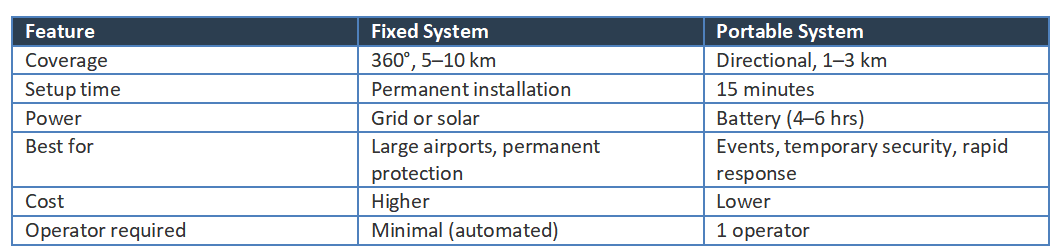
Fixed installations are permanently mounted at strategic locations around the airport perimeter. They are ideal for large international airports with high traffic volumes and significant security requirements.
Haisen Spectrum Full Frequency Bands system provides:
· 360° permanent coverage
· Solar-powered or grid-connected operation
· Integration with airport security operations center
· Weatherproof enclosure rated for extreme climates
· Remote monitoring and control via secure network
Portable Anti-Drone Systems
Portable systems are designed for rapid deployment at temporary events, VIP visits, or incident response scenarios. They can be set up by a single operator within 15 minutes.
Haisen Targeted All Frequency Bands portable system features:
Regulatory Considerations for Anti-Drone Jamming
RF jamming is regulated differently across countries. Airport operators must be aware of the following:
· Spectrum licensing: In most countries, jamming equipment requires authorization from the national telecommunications authority
· Aviation authority approval: Civil aviation authorities must approve the deployment of counter-drone systems near airports
· Interference mitigation: Jamming systems must be configured to avoid interfering with air traffic control communications, navigation aids, and other critical aviation frequencies
· Legal framework: Some countries restrict jamming to military and law enforcement agencies; commercial airport operators may need to coordinate with national security services
Haisen Global provides regulatory compliance support, including documentation for spectrum licensing applications and coordination with aviation authorities during system deployment.
Anti-Drone Defense for Emerging Market Airports
Airports in Africa, the Middle East, Central Asia, and Latin America face unique challenges in counter-drone defense:
· Limited regulatory framework: Drone registration and operator licensing may not be fully implemented, increasing the likelihood of unauthorized drone operations
· Resource constraints: Budget and personnel limitations favor automated, low-maintenance systems
· Environmental extremes: Systems must operate reliably in temperatures from -40°C to +55°C, sandstorms, high humidity, and heavy monsoon rains
· Remote locations: Airports far from urban centers benefit from satellite-based remote monitoring
Haisen's anti-drone systems are specifically designed for these conditions, with ruggedized construction, solar power options for off-grid operation, and remote monitoring capabilities that allow centralized management of multiple airport sites.
FAQ: Anti-Drone Jamming Technology
Does anti-drone jamming affect airport communications?
When properly configured, anti-drone jamming systems do not interfere with airport ATC communications, navigation aids, or other critical aviation systems. Haisen's systems use directional antennas that focus RF energy on the drone threat, and the jamming frequencies (2.4 GHz, 5.8 GHz, GPS bands) are different from aviation communication frequencies (118–137 MHz VHF, 329–335 MHz UHF). A thorough site survey and frequency coordination study are conducted before deployment to ensure zero interference.
How effective is RF jamming against military-grade drones?
RF jamming is most effective against consumer and commercial drones that rely on standard RF communication links. Military-grade drones with frequency-hopping spread spectrum (FHSS), encrypted satellite links, and inertial navigation systems are significantly more resistant to jamming. However, Haisen's full-band jamming systems can still disrupt the GPS signals that even military drones rely on for precision navigation, reducing their operational effectiveness.
Can anti-drone systems distinguish between authorized and unauthorized drones?
Yes. Haisen's spectrum detection system can identify drone RF signatures and compare them against a database of known drone models. Authorized drones (such as those operated by airport security, survey teams, or border patrol) can be added to a whitelist, and the system will not engage them. Additionally, the system can identify drone operator IDs (where supported by drone registration databases) to distinguish authorized from unauthorized operators.
What happens to the drone after jamming is activated?
The drone's behavior after jamming depends on its failsafe programming. Most consumer drones (DJI, Autel, Parrot) will either hover in place, land at the current location, or attempt to return to their launch point. Once the drone lands or hovers, airport security personnel can physically secure the device for forensic analysis. The drone is not damaged by the jamming process, allowing identification of the operator through stored flight logs.
How much does an airport anti-drone system cost?
The cost of a complete anti-drone defense system varies based on coverage requirements, number of sensor nodes, and configuration (fixed vs. portable). A basic fixed system for a single runway airport typically starts at $200,000–$500,000, while a comprehensive multi-sensor system for a large international airport can range from $1–3 million. Portable systems start at approximately $50,000 per unit. Haisen Global provides customized quotes based on site-specific threat assessments and coverage requirements.
About Haisen Global: Haisen Technology Co., Ltd. (Haisen Global) is a Hong Kong-based aviation ground support equipment manufacturer founded in 2009. The company designs and produces runway friction testers, aviation weather observation systems (AWOS), anti-drone defense systems, RVR measurement equipment, and aircraft boarding bridges, serving over 200 airports across Africa, the Middle East, Central Asia, and Latin America with ISO 9001 certified manufacturing.
For inquiries about anti-drone defense systems or other airport security solutions, contact Haisen Global at haisenglobal.com.