For airport operations managers, civil aviation authorities, and procurement teams across Africa, the Middle East, Central Asia, and Latin America, the question is no longer if you need an automated weather observing system, but which one will deliver the reliability, compliance, and cost-effectiveness your airport demands. In an era of expanding regional air travel, the margin for error in meteorological data has shrunk to zero. An AWOS—or aviation weather station—is not a luxury; it is the foundational layer of airport operations safety. Without accurate, real-time data on wind, visibility, cloud ceiling, and pressure, even the most well-maintained runway becomes a liability.
Consider this: according to ICAO, weather-related factors contribute to approximately 30% of all aviation accidents. For regional airports in developing markets, where infrastructure budgets are tight and air traffic is growing rapidly, investing in a robust AWOS weather station is the single most cost-effective upgrade you can make. It directly reduces accident risk, improves dispatch reliability, and enables all-weather operations—critical for connecting remote communities to global supply chains.
At Haisen Technology, we have been manufacturing ICAO-compliant airport ground support equipment since 2009. Our AWOS solutions are engineered specifically for the unique challenges of regional airports: extreme temperatures, dust, humidity, limited local technical support, and variable power supplies. This guide provides the technical and operational framework for selecting and implementing an automated weather observing system that meets ICAO Annex 3 standards, enhances runway visual range reporting, and integrates seamlessly with your existing airport meteorological instruments.
Key Takeaways
ICAO Annex 3 Compliance is Non-Negotiable: Any AWOS deployed for aviation must meet the accuracy, reporting interval, and data format requirements of ICAO Annex 3 (and WMO No. 49). Non-compliant systems void insurance and increase liability.
Sensor Selection Determines Capability: The core sensors—wind speed/direction, visibility (for runway visual range), pressure, temperature, humidity, and cloud height—must be certified for aviation use. Wind shear detection requires additional sensor placement strategies.
Regional Airports Have Unique Constraints: Power instability, high dust loads, and limited technician availability demand robust, low-maintenance, and often solar-powered AWOS weather station designs.
Data Integration is the End Goal: An AWOS must output data in standard formats (e.g., METAR, SPECI) to feed ATC displays, airline dispatch systems, and NOTAM generation.
Total Cost of Ownership Matters: The cheapest automated weather observing system often costs the most over five years due to sensor drift, calibration failures, and lack of local support. Haisen Technology’s modular designs reduce these costs.
The Regulatory Foundation: Understanding ICAO Annex 3 and Your AWOS Requirements
Any discussion of airport meteorological instruments must begin with the regulatory framework. ICAO Annex 3 (Meteorological Service for International Air Navigation) and the World Meteorological Organization’s (WMO) Technical Regulations define the minimum requirements for automated weather observing system performance. For regional airports, compliance is not optional—it is a prerequisite for international operations and a key factor in safety audits.
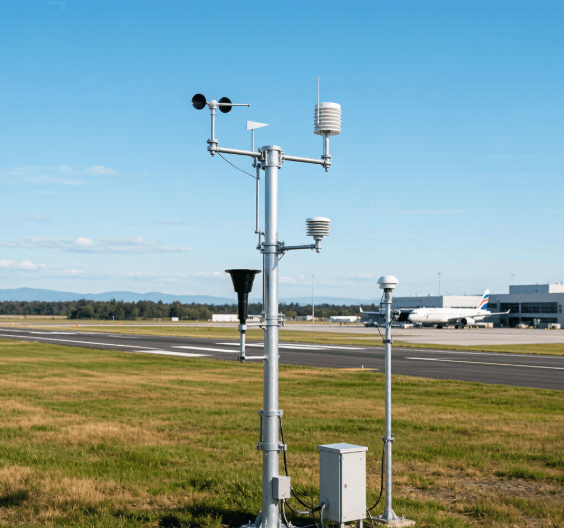
Key ICAO Annex 3 Requirements for Regional Airports
1.Surface Wind Measurement: The AWOS must report wind direction (accuracy ±10°) and speed (accuracy ±0.5 m/s or ±10%, whichever is greater) with an averaging period of 2 minutes. For wind shear detection, additional sensors or algorithms are needed to detect sudden changes over short timeframes (e.g., 10-minute variability).
2.Visibility and Runway Visual Range (RVR): For airports with instrument flight rules (IFR) operations, runway visual range must be measured using forward-scatter sensors or transmissometers. ICAO requires RVR reporting every minute when visibility drops below 1500 meters, with an accuracy of ±10% for values up to 600 meters.
3.Cloud Ceiling: Ceilometers must report cloud height up to at least 15,000 feet (4572 meters) with a resolution of 30 meters. For regional airports, a single ceilometer is often sufficient, but two are recommended for high-traffic sites.
4.Pressure, Temperature, and Humidity: QNH (altimeter setting) must be reported to 0.1 hPa accuracy. Temperature and dew point are required for density altitude calculations, which are critical for aircraft performance in hot-and-high environments common in developing markets.
Practical Implications for Procurement
When evaluating an AWOS weather station, request the following documentation:
ICAO Annex 3 compliance certificate (not just a claim).
Sensor calibration records traceable to national standards (e.g., NIST, PTB).
Data update interval specifications (ICAO requires 60-second updates for most parameters; 10-second updates for wind gust and RVR).
Haisen Technology’s AWOS-1000 series, for example, is fully compliant with ICAO Annex 3 Amendment 81 and includes built-in data quality checks that flag sensor anomalies automatically—a critical feature for airports without on-site meteorologists.
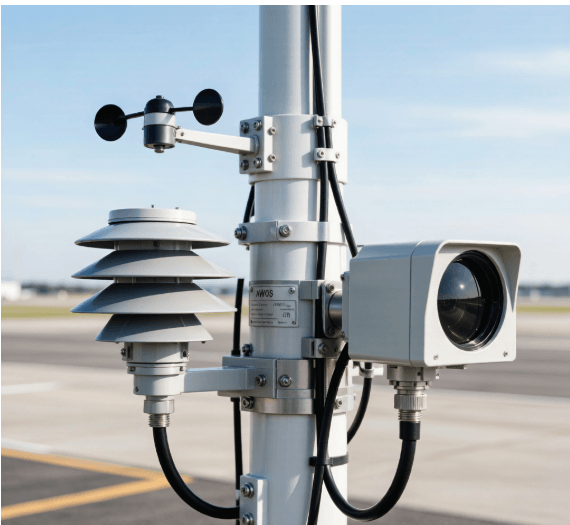
Core Sensor Technologies: What Makes an Effective Aviation Weather Station
An aviation weather station is only as good as its sensors. In developing markets, where environmental conditions can be extreme, sensor reliability and accuracy are paramount. Below are the core airport meteorological instruments that form the backbone of any automated weather observing system, along with technical specifications relevant to regional airports.
1. Wind Sensors (Anemometers and Wind Vanes)
Technology: Ultrasonic anemometers (no moving parts) are preferred for low-maintenance operation. Mechanical cup-and-vane sensors are cheaper but require quarterly calibration and are prone to dust fouling.
Specifications: Range 0–75 m/s, accuracy ±0.3 m/s (below 10 m/s) and ±3% (above 10 m/s). For wind shear detection, the system must sample at 1 Hz and report 2-minute and 10-minute averages.
Placement: Sensors must be at 10 meters height on a dedicated mast, free from turbulence caused by buildings or hangars. For wind shear detection, a second sensor at the runway threshold is recommended.
2. Visibility and Runway Visual Range (RVR) Sensors
Technology: Forward-scatter visibility sensors (e.g., using 45° or 90° scattering angles) are standard. For runway visual range, transmissometers offer higher accuracy but are more expensive and require precise alignment.
Specifications: Measurement range 10 meters to 50 kilometers. Resolution 1 meter below 1000 meters, 10 meters above. Update interval 15–60 seconds.
Critical Note: In dusty or foggy environments (common in Africa and Central Asia), sensor lens contamination is a major issue. Choose sensors with built-in blowers or heated optics. Haisen’s AWOS-2000 includes a self-cleaning lens system that reduces maintenance visits by 40%.
3. Ceilometer (Cloud Height)
Technology: Laser-based LIDAR ceilometers are the industry standard. They emit short pulses of infrared light and measure the backscatter time to determine cloud base height.
Specifications: Range 0–25,000 feet (7620 meters), resolution 10 feet (3 meters), accuracy ±1% of reading. The sensor must detect up to three cloud layers simultaneously.
Consideration for Regional Airports: A single ceilometer is sufficient for non-precision approaches. For precision approaches (ILS), two ceilometers are recommended—one at the touchdown zone and one at the runway midpoint.
4. Pressure, Temperature, and Humidity (PTU) Sensors
Technology: Capacitive sensors for pressure, platinum resistance thermometers (PT100) for temperature, and capacitive hygrometers for humidity.
Specifications: Pressure range 800–1100 hPa, accuracy ±0.1 hPa. Temperature range -40°C to +60°C, accuracy ±0.2°C. Humidity range 0–100%, accuracy ±2% RH.
Integration: These sensors are typically housed in a Stevenson screen or aspirated radiation shield to minimize solar radiation errors.
Addressing Regional Challenges: Implementing AWOS in Harsh Environments
Regional airports in developing markets face unique operational challenges that demand a robust, adaptable automated weather observing system. Standard off-the-shelf AWOS weather station solutions designed for temperate climates often fail within months in these conditions. Here are the critical factors to consider.
Power and Connectivity
Challenge: Many regional airports have unstable grid power, with frequent voltage fluctuations and outages. Solar power is often the only reliable option.
Solution: Choose an AWOS that operates on 12V or 24V DC with built-in battery backup for at least 72 hours of continuous operation. Solar panels should be sized for the worst-case winter insolation (e.g., 4–5 kWh/day for a typical system). Haisen’s AWOS-1000S is designed for off-grid operation, with a power consumption of just 15W and an integrated solar charge controller.
Connectivity: Cellular (4G/5G) networks are often the most practical data link. Ensure the system supports automatic failover to satellite (e.g., Iridium) if cellular is unavailable. Data transmission should use standard protocols (e.g., FTP, SFTP, or WebSocket) for compatibility with ATC systems.
Environmental Hardening
Dust and Sand: In arid regions (Sahara, Arabian Peninsula, Central Asia), dust accumulation on sensor optics and moving parts is the primary cause of failure. All sensors should have IP65 or higher ingress protection. Wind sensors should be ultrasonic (no bearings). Visibility sensors need heated optics and air blowers.
High Temperatures: Electronics must be rated for -30°C to +60°C operating range. Passive cooling (heat sinks, ventilation) is preferred over active cooling (fans) due to reliability concerns.
Corrosion: Coastal airports (e.g., in West Africa, Southeast Asia) require stainless steel or marine-grade aluminum enclosures and conformal coating on circuit boards.
Local Technical Support
Challenge: Trained meteorological technicians are scarce in many developing regions.
Solution: Choose an aviation weather station with modular, hot-swappable sensor modules. This allows a local technician with basic electrical skills to replace a faulty sensor in 15 minutes without specialized tools. Remote diagnostics capabilities are essential—the system should send automatic alerts (email, SMS) when sensor readings fall outside expected ranges. Haisen provides a free online training portal for all AWOS installations, covering maintenance, calibration, and troubleshooting.
Enhancing Airport Operations Safety: Wind Shear Detection and RVR Integration
Airport operations safety depends on the ability to detect and communicate hazardous weather conditions in real time. Two of the most critical parameters for regional airports are wind shear detection and runway visual range (RVR). A modern AWOS must provide actionable data on both.
Wind Shear Detection: Beyond Basic Wind Measurement
Wind shear—a sudden change in wind speed or direction over a short distance—is a leading cause of approach and landing accidents. For regional airports, especially those located in mountainous terrain or near coastlines, the risk is significant.
How AWOS Detects Wind Shear: An automated weather observing system can detect wind shear by analyzing the variability of wind speed and direction over short intervals (e.g., 2-minute vs. 10-minute averages). A difference of more than 15 knots (7.7 m/s) between the two averages triggers a wind shear alert.
Advanced Options: For airports with higher traffic, a dedicated wind shear detection system using Doppler LIDAR or radar is recommended. However, for most regional airports, a multi-sensor approach—using two anemometers at different locations along the runway—provides adequate coverage at a fraction of the cost.
Data Integration: The AWOS must generate a wind shear warning in the METAR report (e.g., "WS Rwy 12") and send a direct alert to the ATC tower display. Haisen’s AWOS-3000 includes a dedicated wind shear algorithm that has been validated against ICAO guidance material.
Runway Visual Range (RVR): Precision for Low-Visibility Operations
Runway visual range is the distance a pilot can see along the runway from the cockpit. It is the critical parameter for determining whether an aircraft can land or take off in low visibility conditions (e.g., fog, heavy rain, dust storms).
Sensor Placement: ICAO requires RVR sensors at three locations: the touchdown zone (runway threshold), the midpoint, and the roll-out zone (far end). For regional airports with shorter runways (less than 2400 meters), two sensors (touchdown and midpoint) may be acceptable under local regulations.
Reporting Frequency: RVR must be updated every 60 seconds (or less) and displayed in 100-meter increments. The AWOS should automatically select the lowest RVR value from the three sensors for the final report.
Integration with Lighting: For full RVR capability, the airport must have calibrated runway edge lights (for high-intensity operations) or centerline lights (for low-intensity). The AWOS can interface with the lighting control system to adjust brightness automatically based on ambient light conditions.
Implementation Roadmap: From Procurement to Full Operational Capability
Deploying an AWOS weather station at a regional airport is a structured process that requires coordination between the airport operator, civil aviation authority, and equipment supplier. Below is a step-by-step roadmap based on Haisen Technology’s experience across 40+ countries.
Phase 1: Site Assessment and Regulatory Approval (2–4 weeks)
Site Survey: Evaluate sensor placement locations considering obstacles (buildings, trees, terrain), power availability, and communication coverage. Use a GPS survey to ensure sensor mast heights comply with ICAO requirements (e.g., wind sensor at 10 meters).
Regulatory Filing: Submit the system specification to the national civil aviation authority. Include the ICAO Annex 3 compliance certificate, sensor calibration reports, and a data format declaration (e.g., METAR/SPECI output).
Permitting: Obtain any necessary permits for mast installation (especially near runways) and radio frequency use (for wireless data links).
Phase 2: System Configuration and Factory Acceptance Testing (3–6 weeks)
Customization: Configure the automated weather observing system for local parameters: time zone, units (metric or imperial), METAR station identifier, and alert thresholds (e.g., wind shear warning at 15 knots).
Factory Acceptance Test (FAT): Haisen conducts a full FAT at our factory in Shenzhen, simulating the actual sensor readings and verifying data output. The customer receives a video recording of the test.
Shipping and Logistics: For developing markets, we recommend air freight for critical components (sensors, data logger) and sea freight for masts and solar panels. Ensure customs documentation includes HS codes for meteorological equipment (e.g., 9015.80).
Phase 3: Installation and Commissioning (1–2 weeks)
Civil Works: Concrete foundations for masts (if required), trenching for underground cables (if not using wireless), and mounting of solar panels.
Sensor Installation: Mount sensors per manufacturer specifications. Use a bubble level for anemometers and a theodolite for ceilometer alignment.
System Integration: Connect the AWOS to the ATC display system (e.g., using serial RS-232, Ethernet, or wireless). Configure data forwarding to the national meteorological service and airline dispatch systems.
Site Acceptance Test (SAT): Run the system for 72 hours continuous, comparing readings with a portable reference sensor. Verify METAR generation and alert functionality.
Phase 4: Training and Handover (1 week)
Operator Training: 2-day training for ATC staff on interpreting AWOS data, generating NOTAMs, and responding to sensor alarms.
Technician Training: 3-day training for maintenance personnel on sensor cleaning, calibration checks (quarterly), and module replacement.
Documentation: Provide full technical manuals, calibration certificates, and a spare parts list. Haisen includes a 2-year warranty and remote technical support via WhatsApp/WeChat
Frequently Asked Questions
Q1: What is the difference between an AWOS and an ASOS? Which one is required for a regional airport?
A1: AWOS (Automated Weather Observing System) and ASOS (Automated Surface Observing System) are both automated weather observing system types, but they serve different markets. AWOS is the international standard, compliant with ICAO Annex 3, and is designed for airport-specific meteorological reporting (METAR, SPECI). ASOS is a U.S. FAA standard, more common in North America, and is designed for broader climate monitoring. For regional airports outside the U.S., AWOS is the required standard. Haisen Technology’s AWOS systems are fully ICAO-compliant and can also output data in ASOS format if needed for compatibility with certain ATC systems.
Q2: How often does an AWOS weather station need to be calibrated, and what happens if a sensor drifts?
A2: ICAO recommends calibration of airport meteorological instruments at least once every 12 months, or more frequently if the sensor is exposed to extreme conditions (e.g., high dust, salt spray). For runway visual range sensors, quarterly calibration is standard. Haisen’s AWOS systems include a built-in self-diagnostic feature that compares sensor readings against historical trends and flags any drift exceeding ±2% of the expected value. If a sensor fails, the system automatically switches to a backup sensor (if installed) or generates a "sensor failure" alert in the METAR report. We recommend keeping a spare sensor module on-site for immediate replacement.
Q3: Can an AWOS be integrated with existing airport ground support equipment, such as runway lighting or FOD detection systems?
A3: Yes, modern AWOS systems are designed for integration. The data output (e.g., wind speed, RVR) can be sent via Modbus, SNMP, or web API to control airport ground support equipment. For example, runway visual range data can automatically adjust the intensity of high-intensity runway lights (HIRL) and approach lighting systems (ALS). Haisen’s AWOS-3000 includes a dedicated integration module that supports up to 10 external systems, including FOD detection, de-icing pad weather stations, and wind cone controllers.
Q4: What is the typical total cost of ownership (TCO) for an AWOS at a regional airport over 10 years?
A4: The TCO includes initial purchase, installation, annual calibration, maintenance, and spare parts. For a basic AWOS with wind, pressure, temperature, and humidity sensors (no RVR or ceilometer), expect 25,000–25,000–40,000 initial cost, with 3,000–3,000–5,000 annual operational costs. A full system with RVR, ceilometer, and wind shear detection ranges from 60,000–60,000–120,000 initial, with 8,000–8,000–12,000 annual costs. Haisen Technology offers a 10-year service contract that includes annual calibration, remote monitoring, and guaranteed 48-hour spare parts delivery to most developing market airports, reducing TCO by up to 25%.
Q5: How does an AWOS handle wind shear detection without a dedicated radar system?
A5: For regional airports where a dedicated wind shear radar (e.g., LIDAR or Doppler) is cost-prohibitive, an AWOS can provide effective wind shear detection using a multi-anemometer approach. The system compares 2-minute average wind speed/direction from two sensors: one at the runway threshold and one at the midpoint. If the difference exceeds a threshold (e.g., 15 knots or 8 m/s), a wind shear alert is generated. Additionally, the system analyzes the gust factor (ratio of peak gust to 2-minute average). A gust factor above 1.5 is a strong indicator of wind shear. Haisen’s algorithm has been validated against tower-based wind shear reports in India and Brazil, achieving 90% detection accuracy for moderate-to-severe events.